












Solar Panel Installation in Kottivakkam
Society route claims ₹18,000 per kW, which beats the household cap on any block of size
Kottivakkam has more apartment blocks than the villa stretches further down the ECR, and that changes the route rather than just the size. For most residents here the practical path to solar runs through the association, not through their own roof.
Installing across Chennai since 2020
Two years free maintenance included
Subsidy and TANGEDCO paperwork filed by us
Free site survey and energy audit, no obligation
The short answer
Looking for a solar panel installation company in Kottivakkam?
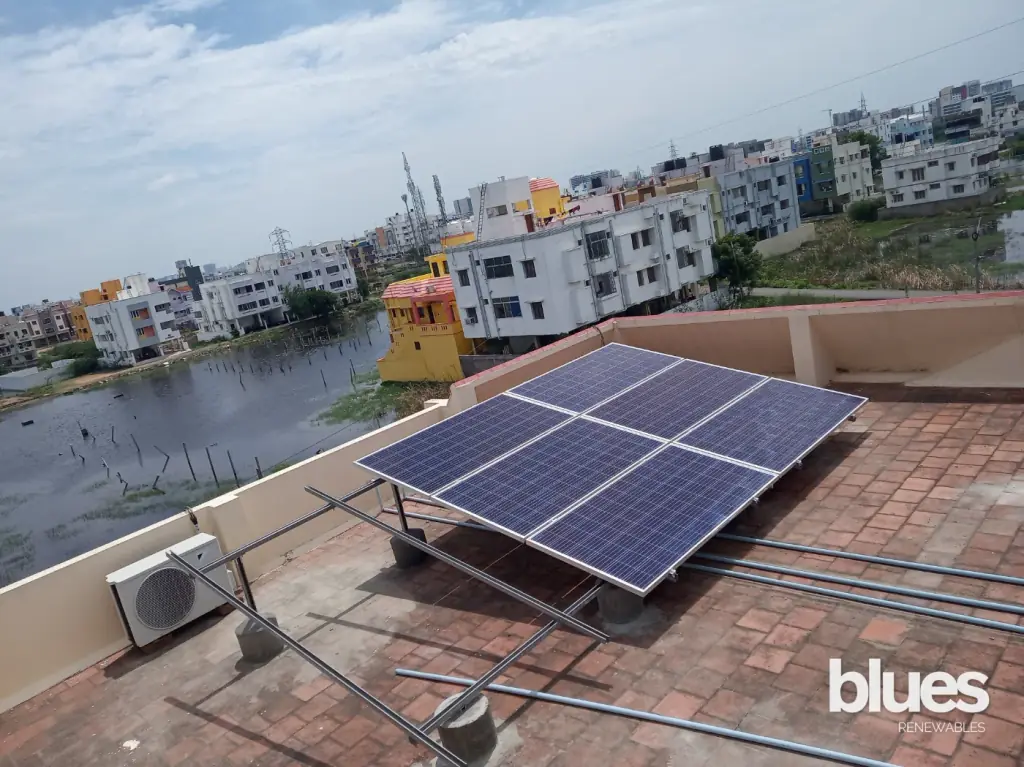
In Kottivakkam we work on both independent terraces and apartment common areas, and the two need different paperwork even on the same street. Coastal exposure changes the hardware list here: salt-mist rated modules, galvanised structure, and outdoor enclosures rated for the humidity. Blues Renewables has worked across Chennai since 2020. We handle the PM Surya Ghar claim of up to ₹78,000 where the property is residential, file the TANGEDCO net metering paperwork, and include two years of maintenance. Before the survey, you can check the solar panel price in Chennai for 3 kW to 10 kW systems and see how our solar panel installation in Chennai works, the same process we follow in Kottivakkam.
What it costs here
A typical 5 kW system in Kottivakkam
Standard 5 kW example
What a typical 5 kW home system does here. Your own figures come from the survey.
Not sure what your site can carry?
Send us your last electricity bill on WhatsApp and we will come back with an indicative system size and what it would offset. No visit needed for that first answer.
The local picture
An apartment coastline
Kottivakkam’s residential stock is more apartment-based than the villa areas further south along the ECR, which means the majority of residents cannot install individually. The terrace of an apartment building is common property belonging to all owners collectively, and applications submitted individually against a society address are typically rejected at the feasibility stage. The workable route is a common-area system through the association.
Why the society route is usually better anyway
₹18,000 per kW rather than a ₹78,000 cap
Up to 500 kW and subject to 3 kW per residential unit.
The loads match generation
Lifts, pumps, borewell motors and the STP run through daylight hours, so most output is consumed on site rather than exported.
The saving reaches every flat
Since common-area electricity is funded from maintenance charges.
EV charging is covered
By the same provision.
Not optional here
Coastal specification, and wind design to match
Kottivakkam sits close to the sea, and salt-laden air corrodes module frames, mounting structures and fasteners considerably faster than inland. IEC 61701 certified modules and hot dip galvanised or aluminium structures are the minimum, and on an apartment block that is a substantial quantity of steel to get wrong. Sea-facing terraces are structurally exposed too: wind loading on a coastal block is significant, and structures and foundations need designing to the requirement rather than built to a template.
What often decides the vote
Terrace access matters to residents
An elevated structure up to 9 feet keeps the space walkable underneath, which is frequently what makes a proposal acceptable to a general body rather than merely affordable. It also shades the roof slab, which top-floor owners notice.
Areas we cover around Kottivakkam: ECR, Kottivakkam beach side, Thiruvanmiyur border, Palavakkam approach, Vinayaga Nagar, the service road stretch.
All areas we cover in Chennai →Residential
Solar for Kottivakkam homes
Apartment associations
The main route, with common-area systems claiming ₹18,000 per kW.
Individual flat owners
Cannot install on a shared terrace, but can propose it to the association. We prepare the assessment free.
Independent houses
Fewer here, typically installing 3 kW to 5 kW with coastal specification.
Elevated structures
Preserve resident terrace access and shade the slab beneath.
Commercial and industrial
Solar for Kottivakkam businesses
Restaurants and cafés
Along the ECR. Daytime refrigeration and cooling suit solar; evening trading does not.
Guest houses and serviced apartments
Variable occupancy needs twelve months of bills rather than an average.
Clinics and small offices
Good daytime match and commercial tariffs.
Retail on the frontage
Evening-weighted and usually leased.
Local guide
Kottivakkam solar: the beach end and the OMR end are different sites
Kottivakkam runs from the Bay of Bengal at the ECR across to Rajiv Gandhi Salai, the IT corridor. A block near the beach and a house near OMR share a pincode but face different spray, wind and drainage.
Match the hardware to your distance from the beach
Salt-mist rated modules and galvanised or aluminium structure are the baseline across Kottivakkam. The streets nearest the beach need more on top of that. Use stainless steel fasteners and earthing clamps rather than zinc-plated ones, because fasteners corrode first. Mount the inverter indoors, in a stair room or a ventilated utility space, rather than on an open sea-facing wall. Choose sealed enclosures for the junction boxes and keep cable glands on the side away from the wind. Rinse the panels with fresh water more often, because a salt film builds up and cuts output between monsoons. Toward the OMR end the baseline specification is usually enough.
Cyclones reach this coast first
Cyclone Vardah crossed the coast near Chennai on 12 December 2016 with winds of about 105 km/h at landfall. It uprooted about 15 lakh trees and damaged 8,000 transformers. For a Kottivakkam terrace that means three things. Design the structure, clamps and anchors for the full wind load rather than a standard inland detail, especially on an elevated frame. Add a post-cyclone inspection to the maintenance plan, checking clamps, the bolts holding the frame down and any cable that may have chafed. And expect the system to sit idle while the grid is down after a storm: an on-grid inverter restarts on its own once supply returns.
Sandy ground that drains slowly
Rain on this flat coastal strip has nowhere quick to go. Through the 2015 to 2019 monsoons the Corporation placed pumps at 80 locations between Kottivakkam and Uthandi, and roads were dug open to let water drain to the sea. For an apartment block that matters at ground level. The ACDB, the net meter board and any battery should not sit in stilt parking, where standing water collects. Run the cable from the terrace inverter to the meter room above the parking slab where possible, and seal the cable entries into the meter room.
A common-area example for a Kottivakkam block
A 10 kW common-area system on an apartment terrace earns ₹18,000 per kW, or ₹1,80,000 in central subsidy. At Chennai district's 1,600 units per kW a year, it makes about 16,000 units a year, most of which the pumps, lifts and corridor lights use in daylight. The common-area subsidy applies up to 500 kW, subject to 3 kW per flat, so even a small block qualifies for the full rate on a 10 kW system. The panels sit on shared property, so the association's general body has to approve the proposal and the application is filed against the common-area connection, not an individual flat's meter.
What we install
What we install in Kottivakkam
The process
How installation works
Free site survey
Shade-free roof area measured across the day, structure checked, connection name and sanctioned load confirmed.
Design and itemised quotation
Sized against twelve months of consumption, with every component named.
Approvals filed
PM Surya Ghar and TANGEDCO net metering, plus load enhancement or phase conversion in parallel where needed.
Installation
One to three days for a residential system, carried out by our own team rather than subcontracted.
Inspection and commissioning
TANGEDCO inspects, the net meter goes in, the system goes live.
Subsidy tracked to your account
And two years of maintenance included from commissioning.
We check the name on your electricity connection at the survey, because a mismatch stops more applications than any technical issue. See what to keep ready.
Free, no obligation
What will it cost on your roof in Kottivakkam?
Told your flat cannot have solar?
Individually that is right, the terrace is common property. Through your association it is not, and the subsidy is better.
What happens after you send your details
- We call you within one working day, and an engineer rather than a salesperson attends the site.
- The survey is free. We measure usable area and shading, check your connection and sanctioned load, and photograph the site.
- You get an itemised quotation naming every component and brand, with the subsidy or depreciation position set out.
- No obligation at any point. If solar does not make sense for your property, we will say so.
Common questions
Solar in Kottivakkam, common questions
Can I install solar on my Kottivakkam flat?
Not individually, because the terrace is common property belonging to all owners collectively, and individual applications against a society address are usually rejected at feasibility. Propose it to your association instead. We prepare the load assessment and savings projection free, in a form your secretary can put to the general body.
Does a Kottivakkam block need coastal solar specification?
Yes. The locality sits close to the sea, and salt-laden air corrodes module frames, mounting structures and fasteners considerably faster than inland. IEC 61701 salt mist certified modules and hot dip galvanised or aluminium structures are the minimum, and on an apartment block that is a substantial quantity of steel to get wrong.
Will residents lose the use of the terrace?
Not with an elevated structure. Raising the array up to 9 feet keeps the space walkable and shaded underneath, which is frequently what makes a proposal acceptable to a general body. It also shades the roof slab, which reduces heat gain into the top-floor flats.
How long does installation take in Kottivakkam?
Six to ten weeks in Kottivakkam. Lead time on salt-mist certified modules and galvanised structure can add a few days at the procurement stage, which we tell you at quotation rather than after you have signed.
Do you handle the subsidy and TANGEDCO paperwork?
Yes. We file the PM Surya Ghar application and the TANGEDCO net metering paperwork, and follow both through the section office. One point specific to coastal properties like those in Kottivakkam: the hardware has to be ALMM-listed for the subsidy, and the salt-mist rated modules we specify here are, so the specification never puts the claim at risk.
What is included after installation?
Two years of free maintenance from commissioning, covering panel cleaning, annual inspection of connections and structure, generation monitoring and warranty coordination with the manufacturer.
Does a house at the OMR end of Kottivakkam need the same salt protection as a block on the beach?
It needs the baseline: salt-mist rated modules and galvanised or aluminium structure. The extra steps, stainless fasteners, an indoor inverter and more frequent freshwater rinsing, matter most on the streets nearest the sea. We decide the specification from the site, not from the pincode.
What happens to our Kottivakkam solar system after a cyclone?
The inverter shuts down while grid supply is off and restarts by itself when power returns. After a severe storm, have the structure, clamps and cabling inspected before relying on it, and clear any debris from the array. A structure designed for the coastal wind load is what keeps that inspection routine.
Long tail coverage
Areas we cover around Kottivakkam
Not listed? We survey across Chennai and the surrounding districts. Call and we will tell you straight away whether we can reach your site this week.