












Solar Panel Installation in Saidapet
We tell you in one call whether a leased Saidapet site is worth surveying
Saidapet’s commercial premises tend to be leased on short terms in older buildings. A solar system is designed to last twenty-five years. Those two facts do not reconcile themselves, and the sensible thing is to work out the structure before anyone quotes hardware.
Installing across Chennai since 2020
Two years free maintenance included
Subsidy and TANGEDCO paperwork filed by us
Free site survey and energy audit, no obligation
The short answer
Looking for a solar panel installation company in Saidapet?
Saidapet is tightly packed, and on most terraces here the limit is usable shade-free area, not budget. It sits near the river, so humidity is higher than average and equipment siting needs to account for it. Installing across Chennai since 2020, we file the PM Surya Ghar application worth up to ₹78,000 for households, handle TANGEDCO net metering end to end, and cover two years of maintenance after commissioning. Before the survey, you can check the solar panel price in Chennai for 3 kW to 10 kW systems and see how our solar panel installation in Chennai works, the same process we follow in Saidapet.
What it costs here
A typical 5 kW system in Saidapet
Standard 5 kW example
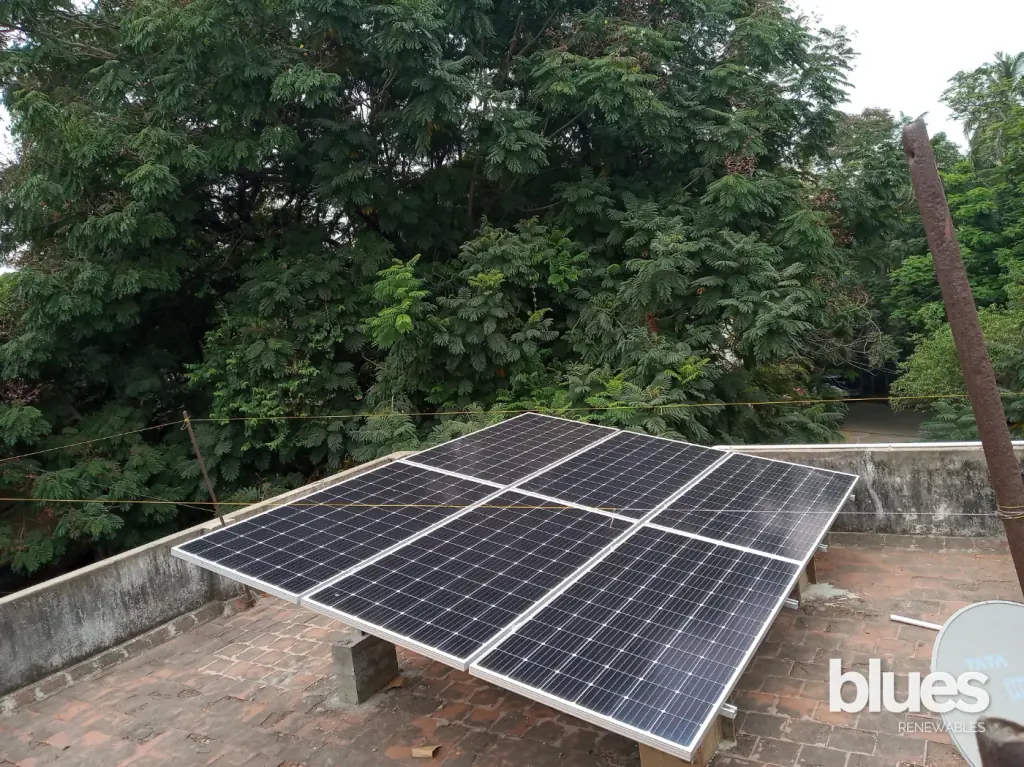
What a typical 5 kW home system does, on a terrace that can take one. Your own figures come from the survey.
Not sure what your site can carry?
Send us your last electricity bill on WhatsApp and we will come back with an indicative system size and what it would offset. No visit needed for that first answer.
The local picture
Short leases and a twenty-five year asset
A rooftop solar system is designed for around twenty-five years. Commercial tenancies in Saidapet are frequently much shorter, often three to five years, and in older multi-occupant buildings the roof usually belongs to the owner rather than any occupant. Committing capital to a long-life asset on a short-term interest in a property needs structuring rather than assuming.
The questions in order
Do you control the roof at all?
In a multi-occupant older building, usually not. The terrace belongs to the owner.
How long is left on your lease, and is renewal secure?
A five-year lease and a twenty-five year asset need the exit position documented before installation.
Who owns the system at lease end, and who pays to remove it?
Settle this in writing, not by assumption.
Is the landlord a better investor than you are?
Frequently yes, with the benefit passed through the lease terms.
Structures that work on a short tenure
Landlord installs, tenant benefits through the lease
The cleanest arrangement where the building has several occupants.
An OPEX or RESCO agreement
Where a developer owns the system and you pay per unit consumed. This can align to a lease term far more comfortably than ownership.
A shorter payback target
Where you will genuinely be there ten years, a smaller system sized to pay back within that window is a better decision than one sized to consumption.
The honest position
We will say before we visit whether a site is worth surveying
Roof rights and tenure determine that more often than anything technical, and a wasted survey costs us both time. Residential Saidapet is dense older stock with tight plots, narrow lanes and usable roof area well below terrace measurement, so systems typically run 3 kW.
Areas we cover around Saidapet: Saidapet, Guindy border, Little Mount approach, West Saidapet, Jones Road, the Anna Salai frontage.
All areas we cover in Chennai →Residential
Solar for Saidapet homes
Independent houses
In the residential streets, typically 3 kW once usable area is measured.
Older properties
May have sloped sections and divided ownership needing settling first.
Apartment blocks
Follow the association route for common-area systems.
Access on narrow lanes
Planned at survey rather than discovered on installation day.
Commercial and industrial
Solar for Saidapet businesses
Shops and retail in older leased premises
Roof rights and tenure come before anything technical.
Small offices and service businesses
Good daytime load where the roof is available.
Clinics and practices
Daytime match and commercial tariffs.
Mixed-use buildings
Where the tariff category on the connection determines the subsidy route.
Local guide
Solar for Saidapet homes and buildings: the river, new blocks and small roofs
Much of Saidapet is low lying, and in the 2015 floods the Adyar rose to the Maraimalai Adigal bridge and washed away homes on the river bed. How close a building is to the river is the first local question for where the solar equipment goes.
Streets near the Adyar and the 2015 flood line
Saidapet sits about 5 km west of the point where the Adyar meets the sea, and much of it is low lying on sandy loam. In the 2015 floods the river rose as high as the Maraimalai Adigal bridge, and families living on the river bed lost their homes. For houses in the streets nearest the river, our design decision is to fix the inverter and the AC and DC distribution boxes on a first floor wall or in the terrace stair room, never in a ground floor passage or meter room. Cable runs go down inside the building, with joints kept above ground floor level. The panels themselves are safe on the roof. The meter board usually stays where the utility fixed it; only the solar equipment moves up.
New gated communities: plan solar at the drawing stage
Saidapet's character is changing as gated residential communities replace older stock. For a block still being designed or built, the cheapest moment to plan solar is now. Ask the builder to keep the terrace free of scattered tanks and equipment on the south side, to leave a cable duct from the terrace to the electrical room, and to provide anchor points on beams. Once the association takes over, a common-area system for lifts, pumps and lighting gets ₹18,000 per kW. Ask for the lift machine room and water tanks to be grouped on one side of the terrace as well, because scattered structures cast shadows that cut usable area far more than their own footprint.
Single-phase limits on small Saidapet terraces
Many older houses here run on a single-phase connection, which is limited to 4 kW of solar. Small terraces usually land in the 3 kW to 4 kW range, which fits that limit with no phase conversion. At the Chennai yield of 1,600 units per kW a year, 3 kW makes about 4,800 units a year, and the remaining network charge for a home is about ₹0.32 a unit, roughly ₹1,500 a year. A 3 kW system costs about ₹2,10,000 before subsidy and about ₹1,10,000 after both subsidies. Where a house is split between family members with separate connections, each connection can carry its own system, but the terrace should be divided by written agreement first.
What we install
What we install in Saidapet
The process
How installation works
Free site survey
Shade-free roof area measured across the day, structure checked, connection name and sanctioned load confirmed.
Design and itemised quotation
Sized against twelve months of consumption, with every component named.
Approvals filed
PM Surya Ghar and TANGEDCO net metering, plus load enhancement or phase conversion in parallel where needed.
Installation
One to three days for a residential system, carried out by our own team rather than subcontracted.
Inspection and commissioning
TANGEDCO inspects, the net meter goes in, the system goes live.
Subsidy tracked to your account
And two years of maintenance included from commissioning.
We check the name on your electricity connection at the survey, because a mismatch stops more applications than any technical issue. See what to keep ready.
Free, no obligation
What will it cost on your roof in Saidapet?
Short lease on an older building?
Then ownership is probably the wrong structure. Landlord participation or an OPEX arrangement usually fits better, and we will say which.
What happens after you send your details
- We call you within one working day, and an engineer rather than a salesperson attends the site.
- The survey is free. We measure usable area and shading, check your connection and sanctioned load, and photograph the site.
- You get an itemised quotation naming every component and brand, with the subsidy or depreciation position set out.
- No obligation at any point. If solar does not make sense for your property, we will say so.
Common questions
Solar in Saidapet, common questions
Can I install solar on leased premises in Saidapet?
Only with the property owner’s written agreement, and in older multi-occupant buildings the roof usually belongs to the owner rather than any occupant. Where you do have rights, the lease term needs considering against a 25-year asset, with ownership at exit and any removal obligation documented before installation.
What structure suits a three to five year lease?
Rarely outright ownership. Landlord participation with the benefit passed through the lease is the cleanest arrangement in a multi-occupant building, and an OPEX or RESCO agreement, where a developer owns the system and you pay per unit, aligns to a lease term far more comfortably. Where you will genuinely be there ten years, a smaller system sized to pay back in that window also works.
How much solar fits on a Saidapet house?
Typically 3 kW. The residential stock is dense and older, with tight plots and narrow lanes, so usable shade-free area is well below terrace measurement. A partial offset is still worth having, and access is planned at the survey rather than discovered on installation day.
How long does installation take in Saidapet?
Six to ten weeks from survey to a live system. In Saidapet the installation itself can take an extra day because material has to come up by staircase, but the timeline is still governed by TANGEDCO approval and the meter, not by the roof work.
Do you handle the subsidy and TANGEDCO paperwork?
Yes. We file the PM Surya Ghar claim and the TANGEDCO net metering application for you and follow both through the section office. In Saidapet the detail that delays applications most often is the sanctioned load being too low for the system you want, which we check before designing so the load enhancement runs in parallel rather than afterwards.
What is included after installation?
Two years of free maintenance from commissioning, covering panel cleaning, annual inspection of connections and structure, generation monitoring and warranty coordination with the manufacturer.
My house is near the Adyar river in Saidapet. Where should the inverter go?
Above the level water reached in 2015, which in practice means a first floor wall or the terrace stair room. The panels on the roof are not at risk from flooding; the inverter, distribution boxes and cable joints are. We fix their position at the survey.
Our new gated community in Saidapet is still under construction. When should solar be planned?
Before the terrace is finished. A clear south-facing terrace, a cable duct to the electrical room and beam anchor points cost little at construction and save rework later. The association can then claim ₹18,000 per kW for a common-area system.
Long tail coverage
Areas we cover around Saidapet
Not listed? We survey across Chennai and the surrounding districts. Call and we will tell you straight away whether we can reach your site this week.