

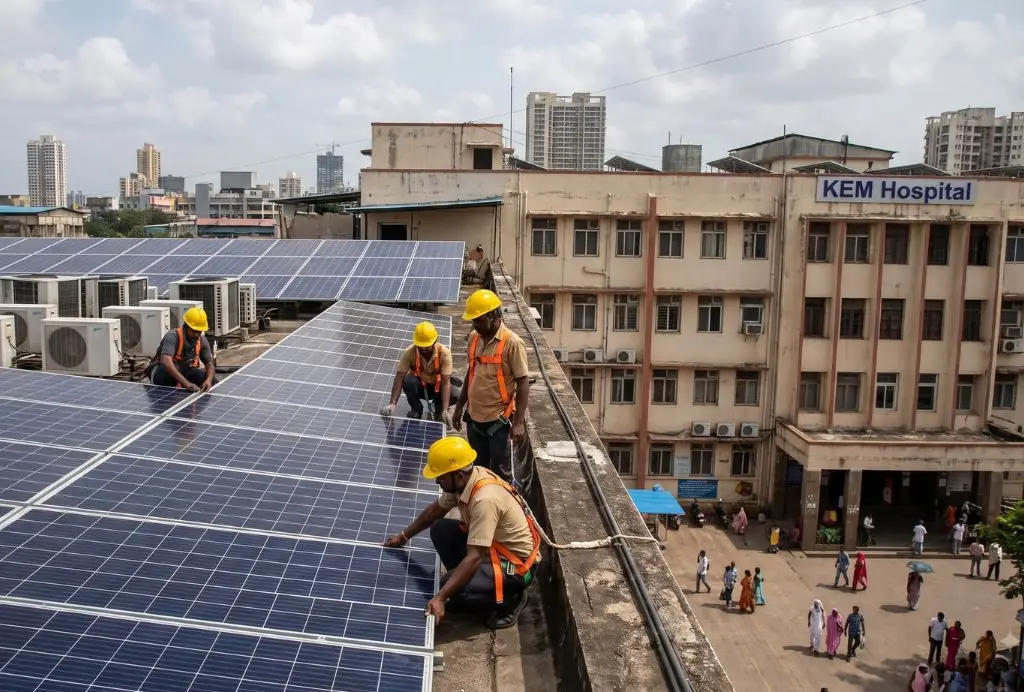

9kW Solar Panel Price in Chennai
9 kW gets the full ₹78,000 subsidy. We price it after a free site survey of your roof.
A 9 kW rooftop system generates around 15,600 units a year, enough for a very large Chennai home, a mid-sized apartment common area or a commercial premises.
Before you settle on 9 kW, one thing is worth knowing: most buyers at this size end up better off at 10 kW, and the reason is the inverter.
A year of generation
15,600
units from a 9 kW roof in Chennai
Size finder
Which size is right for your home?
Recommended size
9 kW
Suits a bi-monthly bill of ₹22,000 to ₹25,250. We price 9 kW after a free site survey.
- Installed
- After survey
- Subsidy
- ₹78,000
- After subsidy
- After survey
Output
How much power does a 9kW solar system generate in Chennai?
A 9 kW rooftop solar system in Chennai generates about 43 units a day, roughly 1,295 units a month, 2,590 units in a TANGEDCO bi-monthly cycle, or around 15,600 units a year. Chennai's approximately 5.3 peak sun hours a day place generation per kW above most of northern India.
| Output | Figure |
|---|---|
| Daily generation | About 43 units |
| Monthly generation | About 1,295 units |
| Bi-monthly generation | About 2,590 units |
| Annual generation | About 15,600 units |
| Bill it offsets | About ₹25,250 per bi-monthly cycle |
A year of generation
15,600
units from a 9 kW roof in Chennai
One kilowatt short of the 10 kW ceiling that governs the subsidy, the export rate and the approval route, for no saving in process.
Roof area needed
720 to 850 sq ft
Shade-free, usable area, not total terrace.
Panels
15 to 17 modules
At 545W to 590W, depending on the module chosen.
Figures assume a shade-free south-facing array with normal soiling and one clean per quarter. Generation is not the constraint at this size, consumption is. A 9 kW system only pays as modelled if the property genuinely uses close to 15,600 units a year.
Our honest recommendation
At 9 kW, a non-subsidy plan is usually the better buy
The residential subsidy is capped, and the cap is reached at 3 kW. Every kilowatt you add above that is paid for entirely by you, so at 9 kW the question is no longer how to maximise the subsidy, it is whether chasing it is worth what it costs you in choice, price and time.
The ceiling is reached at 3 kW
PM Surya Ghar pays ₹30,000 for 1 kW, ₹60,000 for 2 kW and ₹78,000 for 3 kW and above. A 9 kW system receives exactly the same ₹78,000 as a 3 kW one. Past 3 kW the subsidy stops growing while the system keeps getting bigger, so its share of your cost falls with every additional kilowatt.
It narrows what we can install
A subsidised system must use ALMM-listed modules meeting domestic content rules and be registered through the national portal. That rules out several inverters and module lines we would otherwise recommend at this size, and the portal step adds time to the file.
A non-subsidy plan usually wins here
On a 9 kW system the ₹78,000 is a small share of the total. A non-subsidy build gives a wider choice of modules and inverters, a keener price per kW, no portal dependency and a faster commissioning. For most Chennai homes at this size, that is the better deal even before the subsidy arrives.
We quote both ways and show you the difference in writing, subsidised and non-subsidised, side by side, with the equipment named in each. You decide which you would rather have on your roof.
Get both quotesThe decision
9kW or 10kW, which should you choose?
Most buyers considering a 9 kW solar system in Chennai are better served by 10 kW. String inverters are manufactured in standard ratings, commonly 8 kW and 10 kW, so a 9 kW array is usually paired with a 10 kW inverter anyway. Once the inverter, mounting structure, cabling, approvals and installation labour are committed, the tenth kilowatt of panels costs close to panel price alone, and 10 kW is the largest system that still keeps the subsidy, one-for-one net metering and the simpler approval route.
What the tenth kilowatt gets you
- Roughly 1,500 more units a year on the same inverter and the same approvals
- The same ₹78,000 subsidy, the same net metering treatment, the same section-office approval
- No additional TANGEDCO process, since 10 kW is the ceiling rather than beyond it
When 9 kW is genuinely the right answer
- Your usable shade-free roof area stops short of what 10 kW needs
- Your sanctioned load will support 9 kW but not 10 kW, and enhancing it further is impractical
- Your annual consumption is around 15,600 units and the extra capacity would mostly be exported, which returns less than self-consumption
What is your annual consumption?
Likely right size
9 kW, or 10 kW
This is the band where 9 kW genuinely fits, but check the inverter. If the design uses a 10 kW inverter, which it usually will, the tenth kilowatt of panels costs close to panel price alone and adds roughly 1,730 units a year on approvals you have already paid for.
Solar returns come from matching generation to consumption, not from filling the roof. Read what an 8 kW system costs or what a 10 kW system costs.
Send your billsThe essentials
What a 9kW installation involves
A 9 kW installation in Chennai requires a three-phase connection, since TANGEDCO provides three-phase supply for connected loads exceeding 4,000 watts, and a sanctioned load enhancement in nearly all cases. It sits inside the 10 kW ceiling, so the PM Surya Ghar subsidy, one-for-one net metering and the simpler section-office approval route all still apply.
| Detail | |
|---|---|
| Subsidy, individual household | ₹78,000, the cap for all systems 3 kW and above |
| Subsidy, housing society common areas | ₹18,000 per kW, ₹1,62,000 at 9 kW |
| Subsidy, commercial | None. Accelerated depreciation up to 40% year one instead |
| Connection | Three-phase, converted from single-phase where needed |
| Panels | DCR compliant, ALMM listed, mandatory for any subsidy claim |
| Structure | Hot dip galvanised or aluminium, 50 m/s wind zone design |
| Coastal properties | IEC 61701 salt mist corrosion certified modules |
| Metering | Bi-directional net meter; a separate generation meter only above 10 kW |
| Timeline | 8 to 12 weeks, connection work being the main variable |
| Included | Two years of free maintenance |
For the full explanation of what changes at 10 kW and why it matters over 25 years, see what an 8 kW system costs, and the 10 kW ceiling explained. For the application itself, see how TANGEDCO net metering works.
Specification
What a 9kW installation includes
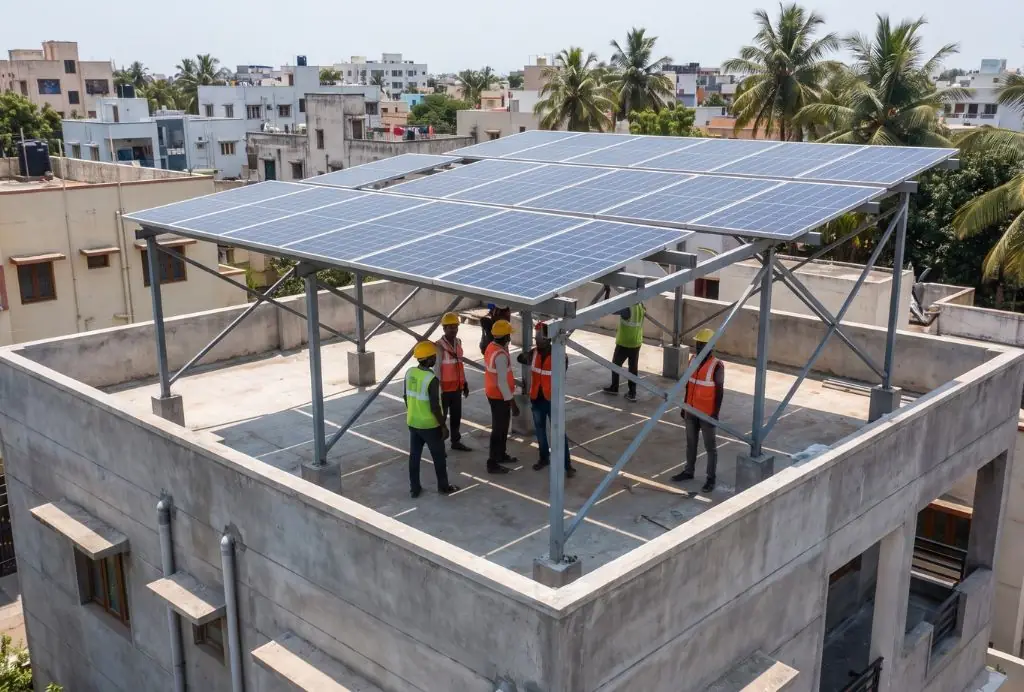
A 9 kW rooftop solar installation in Chennai needs roughly 720 to 850 square feet of shade-free roof area and typically uses fifteen to seventeen panels, depending on module wattage. With the 545 to 590 watt modules common in 2026, sixteen panels is the usual configuration.
On roof area at 9 kW
What matters is usable shade-free area through the middle of the day, not total terrace size. At 9 kW the array rarely sits in one clean rectangle, water tanks, staircase headrooms, parapet walls and neighbouring buildings usually force it across two or more orientations or roof levels.
That is a design problem rather than an obstacle, but it has to be solved on paper before the quote. We survey first, string the array to match what the roof actually offers, and tell you plainly if it will not carry the full 9 kW.
Your quotation
Get your price
Your price depends on your roof, your connection and your array layout, so we quote after a survey rather than from a list. Send us your details and your last EB bill and we will come back with an itemised quotation and a straight recommendation on size, whether that turns out to be 8 kW, 9 kW or 10 kW.
Common questions
9kW solar in Chennai, common questions
What is the price of a 9kW solar system in Chennai?
The installed price depends on whether a three-phase conversion and sanctioned load enhancement are needed, the panel and inverter specification, how the array splits across roof planes, structure type and roof access. It is quoted after a site survey rather than from a price list. Before you commit to 9 kW, it is worth asking whether 10 kW is the better buy, since the inverter is usually the same either way.
How many units does a 9kW solar system generate in Chennai?
About 43 units a day, 1,295 units a month, or roughly 15,600 units a year. Chennai receives around 5.3 peak sun hours daily, higher than most of northern India.
Is 9kW or 10kW better?
For most buyers, 10 kW. String inverters come in standard ratings, commonly 8 kW and 10 kW, so a 9 kW array typically uses a 10 kW inverter anyway. Once the inverter, structure, cabling and approvals are committed, the tenth kilowatt costs close to panel price alone and adds roughly 1,730 units a year. Ten kilowatts is also the ceiling for the subsidy and for one-for-one net metering, so nothing is lost by going to it. Nine kilowatts makes sense mainly when roof area or sanctioned load will not stretch further.
How much subsidy is available on a 9kW solar system?
₹78,000 for an individual household, the cap that applies to all systems of 3 kW and above. Housing societies claiming for common facilities receive ₹18,000 per kW, which at 9 kW is ₹1,62,000. Commercial installations receive no subsidy but can claim accelerated depreciation of up to 40% in year one.
How much roof area does a 9kW solar system need?
About 720 to 850 square feet of shade-free area, using fifteen to seventeen modules at 545 to 590 watts. Insufficient roof area is the most common legitimate reason to install 9 kW rather than 10 kW.
Does a 9kW system need a three-phase connection?
Yes. TANGEDCO provides three-phase supply for connected loads exceeding 4,000 watts, so a 9 kW system requires three-phase and a sanctioned load enhancement in nearly all cases. Both should be filed alongside the net metering application rather than after it.