



Home / Commercial solar / 50 kW solar plant cost
Commercial solar · 50 kW50 kW Solar Plant Cost in Chennai
A 50 kW on-grid solar plant costs ₹22 to ₹25 lakh installed in Chennai in 2026, which is ₹44 to ₹50 a watt including GST. It produces about 80,000 units a year, roughly 220 a day, and on Tamil Nadu commercial tariffs that takes ₹6 to ₹7 lakh a year off the power bill of a business that uses the power in daylight.
50 kW sits on two tariff lines. The LT V fixed charge steps from ₹110 to ₹332 per kW once contracted demand goes above 50 kW, and TNPDCL meters services above 50 kW through current transformers. It is also the size where inflated generation claims are most common. This page covers 40 and 60 kW too, sets out which businesses 50 kW actually fits, and works the payback on an LT commercial bill and an HT bill.
Get an itemised proposalCall +91 98841 0717050 kW at a glance
- Installed price₹22 to 25 lakh
- Before GST₹20.2 to 23 lakh
- Units a yearabout 80,000
- Units a dayabout 220
- Roof needed4,000 to 5,000 sq ft
- Panelsabout 83 to 91
Chennai yield of 1,600 units per kW a year; 550 to 600 Wp panels; shade-free roof. Blues Renewables price bands, October 2026.
What a 50 kW solar system costs in 2026
These are on-grid, turnkey rooftop prices. Turnkey solar contracts carry an effective 8.9% GST: 70% of the value is treated as goods at 5% and 30% as service at 18%. A registered business claims that back, so compare quotes on the before-GST column. Any quote still showing 13.8% GST is using the rate from before 22 September 2025.
Off-grid and hybrid rarely make sense at 50 kW. Your TNPDCL connection already acts as the backup, net feed-in pays for every unit you export, and a battery bank large enough to matter adds a big cost without lowering the energy charge any further.
Every Blues price includes modules, inverters, mounting structure, DC and AC cabling, earthing and lightning protection, the generation meter, CEIG and TNPDCL liaison, installation, commissioning and two years of maintenance. For other sizes, see the commercial solar cost per kW ladder.
Where the money goes at 50 kW
A 50 kW plant uses roughly 87 panels. At JMK Research's Q4 2025 ex-works price for non-DCR modules, ₹14.3 to ₹14.9 per watt, the panels come to about ₹7.2 to ₹7.4 lakh, or around a third of the before-GST price. The table shows what the rest pays for.
If one quote is far below the rest, find out which of these lines is thin. The quote check guide shows how to compare line by line.
Units per day, month and year, and why 2 lakh units is wrong
In Chennai each kW of panels yields about 1,600 units a year. So 50 kW × 1,600 = 80,000 units a year, about 6,670 a month and 220 a day. Districts elsewhere in Tamil Nadu range from 1,550 to 1,700 units per kW, which gives 77,500 to 85,000 units. Output falls by about half a percent a year, so year ten is nearer 76,400 units.
You will see claims that 50 kW makes 2 lakh units a year. That would need 4,000 units per kW, almost 11 units per kW every day, about two and a half times what the Chennai sun delivers. Making 2 lakh units in Chennai takes about 125 kW of panels. A payback built on that figure is overstated by the same two and a half times. Even the sunniest districts at 1,700 units per kW give about 233 units a day from 50 kW, so treat any higher daily figure as a question to put to the seller.
Roof space and panels for 50 kW
Plan on 4,000 to 5,000 sq ft of shade-free roof, at 80 to 100 sq ft per kW. At 575 Wp a panel that is about 87 modules; with 550 or 600 Wp modules the count moves between 83 and 91.
- Metal sheet roofs on showrooms, workshops and godowns cost less per kW, because rails clamp straight to the sheet. Check the sheet's age first. Replace tired sheets before the panels go on.
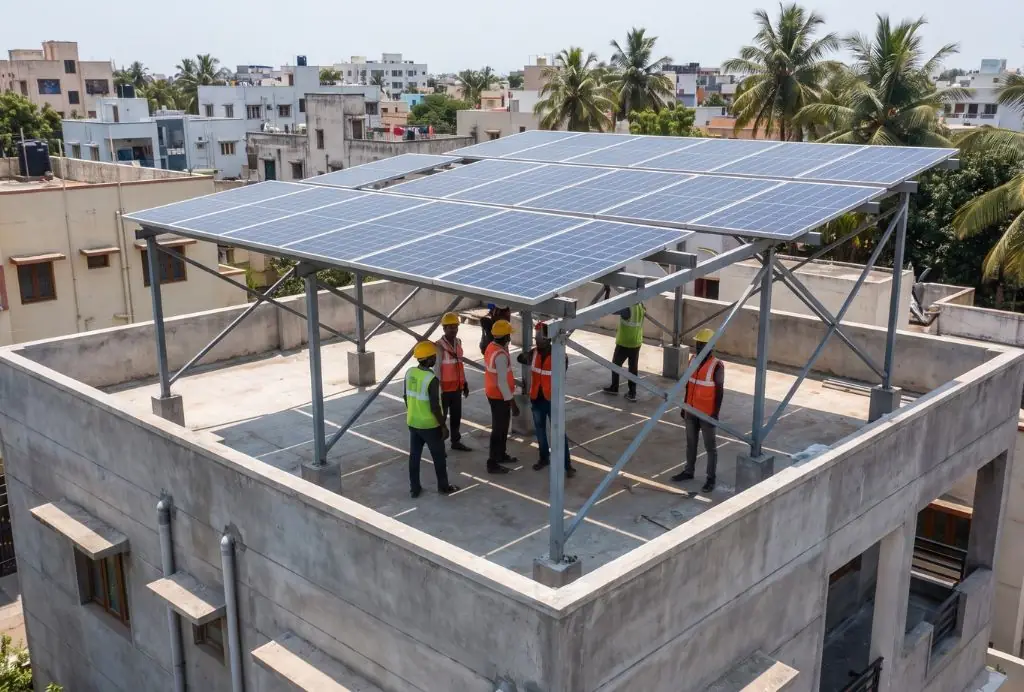
- RCC terraces on hotels and hospitals need an elevated frame so the terrace stays usable, which adds steel. Measure the clear area around tanks and lift rooms, not the plot.
- Split roofs. If the panels sit on two buildings, each inverter set needs its own generation meter.
Subsidy at 50 kW: business, housing society, school or trust
A business gets no capital subsidy. PM Surya Ghar covers homes only. What a business does get is GST input credit and 40% accelerated depreciation on the written-down value. On a plant costing ₹21 lakh before GST, that is ₹8.4 lakh of deduction in the first year, or ₹4.2 lakh if the plant runs for under 180 days in that year. It only helps if you have taxable profit, so ask your CA to model it. Our accelerated depreciation explainer has the detail.
A housing society gets ₹18,000 per kW for common facilities, up to 500 kW, capped at 3 kW per house. At 50 kW that is ₹9 lakh, and the society needs at least 17 houses to claim the full amount.
A school or trust gets no capital subsidy. Private schools pay ₹9.40 a unit on LT IIB(2), and ₹8.25 on HT IIB. A trust that pays no income tax gets nothing from depreciation, so the pay-per-unit route below often suits it better.
Tamil Nadu metering at 50 kW, and the fixed charge solar cannot touch
- Net feed-in. Imports are billed at your tariff; exports earn ₹3.37 a unit as money credit (the 11 to 150 kW band). Credit carries forward, and on 31 March you choose payment or carry-over. Our net metering vs net feed-in guide explains why businesses do not get net metering.
- Network charge on all units generated. ₹1.60 for LT commercial, ₹0.80 for LT industrial (half paid by the state in 2026-27) and ₹1.04 for HT. It is currently levied and under challenge in the Madras High Court.
- CEIG approval and a generation meter are required for anything above 10 kW.
- Fee and route. Apply on the TNPDCL rooftop portal; the fee at 50 kW is ₹700.
- Size cap. The plant cannot exceed your sanctioned load or contracted demand. Our capacity limit guide covers what to do if your load is lower.
The fixed charge step at 50 kW
On LT V commercial, the fixed charge is ₹110 per kW of contracted demand a month up to 50 kW and ₹332 above 50 kW. On LT IIIB industrial it moves from ₹84 to ₹165. This is a charge on your connection, not on your energy, and solar does not reduce it. A business with 60 kW contracted demand pays the higher rate whether it has solar or not. So do not raise your sanctioned load just to fit a bigger plant until the higher fixed charge is in the payback sum.
Which businesses 50 kW fits, by bill and daytime load
Two quick tests. First, the bill: 6,670 units a month at ₹10.45 is about ₹69,700 of energy, so 50 kW suits a commercial building whose monthly energy charge runs past about ₹80,000, with most of that used in daylight. Second, the load: 220 units spread over roughly seven good sun hours means an average draw of about 30 kW. If your building draws that much through the working day, nearly every solar unit stays on site.
Payback worked on an LT commercial bill and an HT bill
Annual saving = (units used on site × your tariff) + (units exported × ₹3.37) − (all units generated × network charge). Both buyers below use 95% of their solar on site. The showroom is on LT V at ₹10.45 and claims GST credit. The hospital is on HT III at ₹9.40, and we use its price including GST in case input credit is not available to it; your CA will confirm.
The hospital's lower network charge offsets most of its lower tariff. If the showroom used only 85% on site, its saving would fall to about ₹6.2 lakh (68,000 × ₹10.45 + 12,000 × ₹3.37 − ₹1,28,000). Self-use matters more than a few rupees on the quote.
Left out of both, in your favour: the 25% peak surcharge from 6 to 10 am, which makes an early-morning solar unit worth ₹11.75 on HT III, and depreciation. What solar never touches: the hospital's ₹608 per kVA demand charge, billed on the higher of recorded demand or 90% of contracted demand. Run your own numbers in the commercial solar ROI calculator, entering your actual quote.
40 kW or 60 kW instead?
Choose 40 kW (₹18 to ₹20.4 lakh including GST, 64,000 units a year) if the clear roof is under 4,000 sq ft, if daytime use is nearer 5,300 units a month, or if the building is a five-day office where weekend output would be exported. The 40 kW case is worked on the 30 to 40 kW page.
Choose 60 kW (96,000 units a year, 4,800 to 6,000 sq ft, about 104 panels) if your sanctioned load is already above 60 kW and daytime use is above about 8,000 units a month. Priced at the 50 kW rate of ₹44 to ₹50 a watt, 60 kW comes to about ₹26.4 to ₹30 lakh including GST, and the rate slides toward the 75 kW band of ₹42 to ₹48 as size grows. The registration fee stays at ₹700. Bigger again, the 100 kW solar plant cost page covers 75 to 150 kW.
CAPEX or RESCO at 50 kW
Buying outright (CAPEX) gives you every unit, the depreciation and the GST credit, and pays back in about three to four years on the examples above. A term loan spreads the outlay; the bank loan guide covers what lenders ask for.
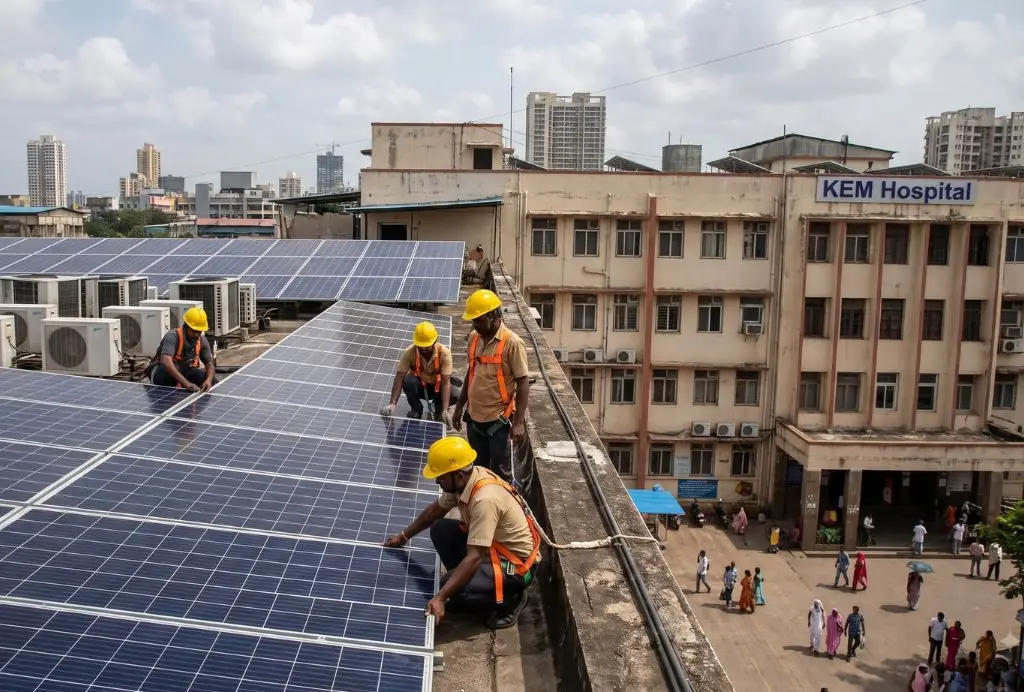
RESCO means a developer owns the plant on your roof and sells you the power at an agreed rate for a fixed term. You pay nothing upfront, but the developer keeps the depreciation. It suits trusts, hospitals that cannot use the tax benefit and tenants on short leases. Compare the RESCO rate with ₹10.45 or your own tariff over the whole term. Our CAPEX vs RESCO comparison sets the two side by side.
Other commercial sizes
50 kW solar, common questions
What is the cost of a 50 kW solar plant in Chennai?
₹22 to ₹25 lakh installed in 2026, including 8.9% GST, which is ₹44 to ₹50 a watt. Before GST it is ₹20.2 to ₹23 lakh, the real cost for a GST-registered business.
How many units does a 50 kW solar plant generate per day?
About 220 units a day on average in Chennai, 6,670 a month and 80,000 a year.
Can a 50 kW solar plant produce 2 lakh units a year?
No. 50 kW × 1,600 units = 80,000 units a year in Chennai. Two lakh units would need about 125 kW. A quote or payback built on 2 lakh units is overstated by about two and a half times.
How much roof area is required for a 50 kW solar plant?
About 4,000 to 5,000 sq ft of shade-free roof, with 83 to 91 panels depending on panel wattage.
Is there a subsidy for a 50 kW solar system for a business?
No capital subsidy. PM Surya Ghar is residential only. A business claims GST input credit and 40% accelerated depreciation. A housing society gets ₹18,000 per kW for common facilities, which is ₹9 lakh at 50 kW.
What is the payback period of a 50 kW solar plant?
About 3 to 3.4 years for a showroom on LT V that uses 95% of its solar, and 3.4 to 3.9 years for a hospital on HT III paying the price including GST.
Will 50 kW of solar reduce my fixed charges?
No. Fixed and demand charges are set by your contracted demand, not your energy use. Solar cuts the energy charge only. On LT V the fixed charge is ₹110 per kW up to 50 kW and ₹332 above.
Can I install 50 kW if my sanctioned load is 40 kW?
Not as it stands. Rooftop solar in Tamil Nadu cannot exceed your sanctioned load or contracted demand. You can apply to raise the load first, but price in the higher fixed charge above 50 kW before you do.
Get a 50 kW proposal sized to your daytime load
Send your last few TNPDCL bills and a photo or sketch of the roof. We check your sanctioned load, your fixed-charge band and your daytime use, then propose 40, 50 or 60 kW with an itemised price and a payback on your own tariff.
An engineer calls back within one working day. We use your bill only to size the system and never pass your details on.
Sources
Blues Renewables price bands for Chennai rooftop installations, October 2026: installed prices for 40, 50 and 75 kW.
TNERC, Suo-motu Tariff Order No. 6 of 2025, 30 June 2025, effective 1 July 2025: LT V ₹10.45 and fixed charges of ₹110 and ₹332 per kW; LT IIIB fixed charges ₹84 and ₹165; HT III ₹9.40 per kWh and ₹608 per kVA demand charge; LT IIB(2) and HT IIB rates; time-of-day surcharge; network charges of ₹1.60 (LT) and ₹1.04 (HT).
TNERC Order No. 4 of 2026, 27 April 2026, Provisional Tariff Subsidy Order FY 2026-27: LT IIIB network charge paid at ₹0.80 after the 50% state subsidy.
TNERC, Grid Interactive Solar PV Energy Generating System Regulations 2021, notified 7 October 2021, and TNERC Order No. 8 of 2021, 22 October 2021: net feed-in for non-domestic consumers, ₹3.37 feed-in tariff for 11 to 150 kW, AC-side capacity, sanctioned-load cap, generation and check meters, registration fees.
TNERC Consolidated Distribution Code as amended up to 31 March 2024: LTCT metering above 50 kW.
CBIC Notification No. 9/2025-Central Tax (Rate), 17 September 2025, in force 22 September 2025: 5% GST on solar power devices; the 70:30 rule gives 8.9% on turnkey contracts.
Income-tax Act 1961, Section 32, and Appendix I of the Income-tax Rules 1962: 40% written-down value depreciation for solar power generating systems, halved for assets used under 180 days.
Energy Department, Government of Tamil Nadu, G.O.Ms. No. 98, 14 October 2024: CEIG approval for generating units above 10 kVA.
JMK Research, module price report Q4 2025: non-DCR modules at ₹14.32 and ₹14.88 per Wp; DCR modules about ₹23 to ₹26 per W as reported by IEEFA, late 2025.