




Home / Commercial solar / 15 kW solar system price
Commercial solar · 15 kW15 kW Solar System Price in Chennai
A 15 kW on-grid solar system costs ₹7.5 to ₹8.4 lakh installed in Chennai in 2026, including 8.9% GST. It makes about 24,000 units a year, roughly 66 a day, and needs 1,200 to 1,500 sq ft of shade-free roof.
15 kW sits just over the 10 kW line, and that line matters in Tamil Nadu. Above it, a home pays a much larger share of the network charge and needs CEIG approval and a generation meter, while a shop, clinic or office gets the same rules it would at any size up to 150 kW. This page prices both buyers and works the payback for each.
Get an itemised proposalCall +91 98841 0717015 kW at a glance
- Installed price₹7.5 to 8.4 lakh
- Per watt₹50 to 56
- Units a yearabout 24,000
- Units a dayabout 66
- Roof area1,200 to 1,500 sq ft
- Panelsabout 25 to 27
Chennai on-grid rooftop, 2026. Units use the Chennai yield of about 1,600 units per kW a year. Panels are 550 to 600 Wp modules.
15 kW price in 2026 for a home and for a business
The installed price is the same for both buyers. What each one actually pays is not, because a home can claim the residential subsidy and a GST-registered business can claim back the GST.
The ₹22,000 state top-up is for homes registered on PM Surya Ghar from 5 August 2026, for the first one lakh consumers. Businesses get neither payment.
The price covers modules, inverter, mounting structure, DC and AC cabling, earthing and lightning protection, the generation meter, CEIG and TNPDCL liaison, installation, commissioning and two years of maintenance. Within the band, the price moves with roof type (a metal sheet roof costs less per kW than RCC with an elevated structure), the module type, the inverter brand, structure height and the cable run down to your meter board.
At ₹50 to ₹56 a watt, 15 kW already costs less per watt than a 10 kW system at about ₹58. The commercial solar cost per kW guide shows how that keeps falling at larger sizes.
Just over the 10 kW line: what a home gives up at 15 kW
A home can install 15 kW and keep net metering, as long as its sanctioned load is at least 15 kW. Tamil Nadu has no 10 kW cap on domestic net metering: the limit is your sanctioned load, as our post on the solar capacity limit and sanctioned load explains. But four things change the moment you go above 10 kW.
The network charge is the one that hurts. It applies to every unit the panels make, not just the extra ones. Going from 10 kW to 15 kW adds 8,000 units a year but adds ₹23,680 of network charge, about ₹2.96 for each extra unit. Our network charge guide explains how it is billed. The charge is currently levied, and it is under challenge in the Madras High Court.
CEIG approval adds a step before commissioning, and the CEIG guide covers what the inspector checks. We handle the application, and its cost sits inside the price above. The generation meter is also included.
One more rule decides whether 15 kW is worth it for a home. Under domestic net metering, any surplus left at 31 March lapses unpaid. A 15 kW system only pays off if the house actually uses about 24,000 units a year, or 4,000 a bill cycle.
Units a day from 15 kW, and how many ACs it runs
In Chennai a 15 kW system makes about 24,000 units a year: about 66 a day and 2,000 a month on average. Other Tamil Nadu districts land within a few percent of that. Output is higher in the dry months and lower in the monsoon, and panels lose about half a percent a year as they age.
To count ACs, check the rating plate for input power. An AC drawing 1.5 kW for 8 hours uses 12 units, so 66 units a day covers about five such ACs for a full working day, averaged over the year. The panels do not feed each AC directly: the grid supplies you when the sun is low, and the meter settles the difference.
For a clinic or small office that runs ACs, lights and computers from morning to evening, 66 units a day often matches most of the daytime load. That match, not the panel count, decides the payback.
Roof area for 15 kW: 1,200 to 1,500 sq ft
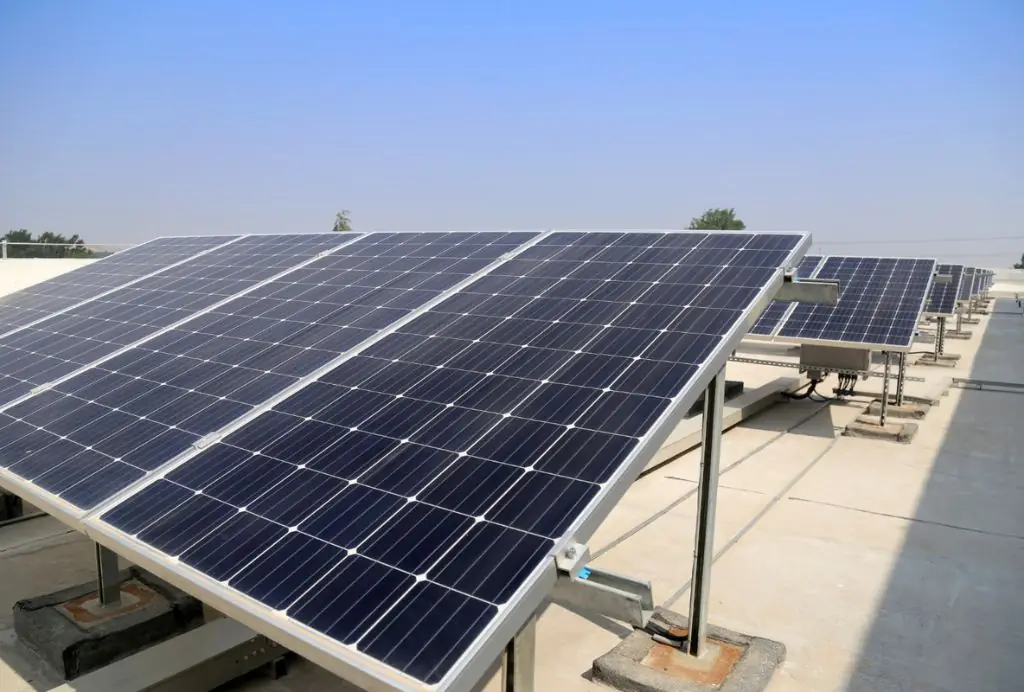
Allow 80 to 100 sq ft of shade-free roof per kW. 15 kW needs about 1,200 to 1,500 sq ft, built from about 25 to 27 panels of 550 to 600 Wp each.
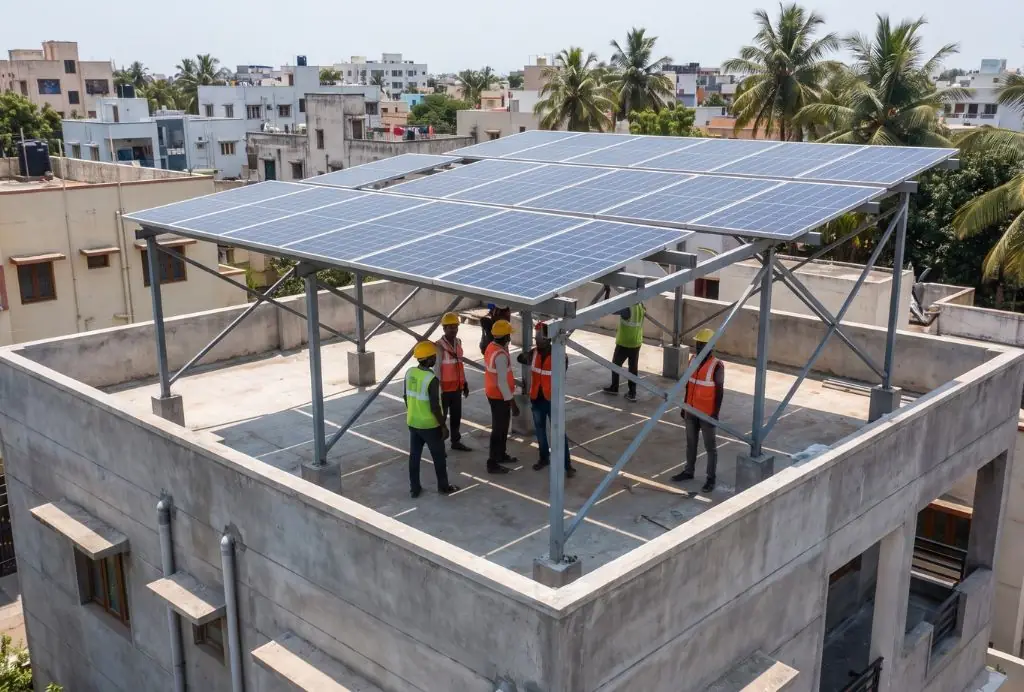
- RCC roofs on homes and offices usually need an elevated structure to clear water tanks and keep the terrace usable. That costs more per kW than a low-tilt mount.
- Metal sheet roofs on workshops and shop sheds take rails clamped to the sheet, the cheaper option, after the sheets and purlins are checked.
- Shade from a neighbouring building, a stair room or a tree cuts output on the whole string, so the survey maps it before the layout is fixed.
If the roof is short of 1,200 sq ft, a 12 kW layout on the same roof keeps every panel in full sun.
15 kW for a shop, clinic or office on LT commercial
Most shops, clinics and offices are on LT V tariff, which charges ₹10.45 a unit for all units once you use more than 100 units in a bill cycle. That high rate is why solar pays back fast for a business that uses its power in daylight. See how it works for retail showrooms and for hospitals and clinics.
A business does not get net metering. It goes on net feed-in: the units you import are billed at ₹10.45, and the units you export are credited in money at ₹3.37 each, the rate for 11 to 150 kW plants. Credit carries forward, and on 31 March you choose payment or carry-over. Our post on net metering versus net feed-in shows a sample bill.
- Network charge: ₹1.60 on every unit generated, in full for LT V. A small workshop on LT IIIB industrial pays only ₹0.80 in 2026-27, because the state pays half.
- Registration fee: ₹500, the band that covers everything up to 20 kW.
- Approvals: apply on the TNPDCL rooftop portal (USRP). TNPDCL does a feasibility study within 15 working days, then CEIG approves the plant before commissioning.
- Fixed charge: LT V pays ₹110 per kW a month up to 50 kW. Solar does not change it.
- Peak hours: LT V pays 25% extra on energy from 6 to 10 am and 6 to 10 pm. Solar covers part of the morning window, which the payback below does not count.
Payback on 15 kW: clinic, office and home compared
For a business, annual saving = (self-used units × ₹10.45) + (exported units × ₹3.37) − (all units × ₹1.60). The clinic opens every day and uses 90% of its solar on site. The office closes on Sundays, so it uses 85%.
A profitable business can also claim 40% accelerated depreciation on the plant in its first year, which shortens the real payback further. It needs taxable profit, and your CA should model it; our post on accelerated depreciation in solar explains the rules.
The home side
A home on net metering saves its own slab rate on every solar unit it uses, so its payback depends on the bill. Find your rate on the bill itself, then read across. This assumes the home uses all 24,000 units, pays ₹28,800 a year in network charge, and paid ₹6.72 to ₹7.62 lakh after the ₹78,000 subsidy.
The two buyers end up close only when the home uses everything it makes. A home that uses 16,000 units and lets 8,000 lapse would do better at 10 kW.
12 kW, 15 kW, or stop at 10 kW?
For a home, the honest answer is often 10 kW. A 10 kW system starts at about ₹5.8 lakh, needs no CEIG approval or generation meter, pays only 20% of the network charge and gets the same ₹78,000 subsidy. Go to 15 kW only if your bills show you use well over 16,000 units a year.
12 kW does not escape the rules: anything above 10 kW needs CEIG, a generation meter and the 75% network charge. It makes about 19,200 units a year and suits a roof that cannot fit 15 kW. Expect its price per watt to fall between the 10 kW and 15 kW figures.
For a business, the line works the other way. The rules are the same at 11 kW as at 150 kW, so size to your daytime load and roof, not to the 10 kW mark. If your load runs to 2,600 units a month or more in daylight, look at a 20 kW system instead.
Other commercial sizes
15 kW solar systems, common questions
What is the price of a 15 kW solar system in Chennai?
₹7.5 to ₹8.4 lakh installed in 2026, including 8.9% GST, or ₹50 to ₹56 a watt. A GST-registered business pays ₹6.9 to ₹7.7 lakh after input credit. A home pays ₹6.72 to ₹7.62 lakh after the ₹78,000 subsidy.
How many units does a 15 kW solar system generate per day?
About 66 units a day on average in Chennai, which is 2,000 a month and 24,000 a year. Sunny months produce more and monsoon months less.
How many solar panels are needed for 15 kW?
About 25 to 27 panels of 550 to 600 Wp each.
How much roof space does a 15 kW system need?
About 1,200 to 1,500 sq ft of shade-free roof, at 80 to 100 sq ft per kW.
Is there a subsidy on a 15 kW solar system?
A home gets the PM Surya Ghar subsidy, but it stops at ₹78,000, the same as for 3 kW. A home registered from 5 August 2026 may also get the ₹22,000 Tamil Nadu top-up if it is among the first one lakh. A shop, clinic or office gets no subsidy; it claims GST input credit and accelerated depreciation instead.
Does a 15 kW home system need CEIG approval?
Yes. Every system above 10 kW needs CEIG approval before commissioning and a separate generation meter. We handle both, and their cost is in the price.
Can a 15 kW solar system run 5 ACs?
On average, yes, for a working day. 15 kW makes about 66 units a day, and an AC drawing 1.5 kW uses 12 units in 8 hours. The grid covers early mornings and evenings.
What is the payback period of a 15 kW solar system?
For a clinic or office on LT commercial tariff, about 3.5 to 4.5 years, depending on self-use and GST registration. For a home, it depends on its slab rate and whether it uses all 24,000 units.
Can a home keep net metering above 10 kW?
Yes, up to its sanctioned load. But it pays 75% of the network charge instead of 20%, needs CEIG approval and a generation meter, and any surplus at 31 March lapses unpaid.
Get a 15 kW proposal for your home or business
Send us your last two electricity bills. We check whether 10, 12 or 15 kW fits your use and roof, then send an itemised price with the payback on your own tariff.
Blues Renewables installs with its own crews from our Guindy office, handles CEIG and TNPDCL, and includes two years of maintenance.
An engineer calls back within one working day. We use your bill only to size the system and never pass your details on.
Sources
Blues Renewables price bands for Chennai rooftop installations, October 2026: all installed prices on this page.
TNERC Suo-motu Tariff Order No. 6 of 2025, 30 June 2025, effective 1 July 2025: LT V ₹10.45 a unit above 100 units bi-monthly, ₹110 per kW fixed charge, time-of-day peak surcharge, and LT network charge of ₹1.60 a unit. TNERC Tariff Order 6/2025
TNERC Order No. 4 of 2026, 27 April 2026, Provisional Tariff Subsidy Order FY 2026-27: state pays half the network charge for LT IIIB (₹0.80 paid). TNERC Order 4/2026
TNERC Grid Interactive Solar PV Energy Generating System Regulations 2021, notified 7 October 2021, and TNERC Order No. 8 of 2021, 22 October 2021: domestic net metering up to sanctioned load, net feed-in for other consumers, ₹3.37 feed-in tariff for 11 to 150 kW, network charge at 20% (domestic up to 10 kW) or 75% (domestic above 10 kW), generation meter above 10 kW, surplus lapse at 31 March, ₹500 registration fee up to 20 kW. TNERC GISS Regulations 2021
Government of Tamil Nadu, G.O. Ms. No. 98, Energy Department, 14 October 2024: Electrical Inspector (CEIG) approval before commissioning any generating unit above 10 kVA.
Ministry of Power, Electricity (Rights of Consumers) Amendment Rules 2024, 22 February 2024: no feasibility study up to 10 kW; above that, a study within 15 days or the proposal is deemed feasible.
CBIC Notification No. 9/2025-Central Tax (Rate), 17 September 2025, in force 22 September 2025: 5% GST on solar power devices; with the 70:30 valuation rule, 8.9% on a turnkey EPC contract.
Income-tax Act 1961, Section 32, and Appendix I to the Income-tax Rules 1962: 40% written-down value depreciation on solar power generating systems.
Ministry of New and Renewable Energy, PM Surya Ghar: Muft Bijli Yojana: residential subsidy capped at ₹78,000.
Government of Tamil Nadu, G.O. 102, 19 September 2026: ₹22,000 state top-up for domestic consumers registered on PM Surya Ghar from 5 August 2026, first one lakh consumers.