


Home / Commercial solar / 100 kW solar plant cost
Commercial solar · 100 kW100 kW Solar Plant Cost in Chennai and Tamil Nadu
A 100 kW rooftop solar plant costs ₹41 to ₹47 lakh installed in Chennai in 2026, or ₹41 to ₹47 a watt including GST. It generates about 1,60,000 units a year, which is worth ₹11 to ₹13 lakh a year to an LT business in Tamil Nadu after export credit and network charges, so it pays for itself in roughly three to four years.
100 kW is the size factories, offices, warehouses and supermarkets ask about most, and the one where quotes differ most. This page breaks the price into line items, works the payback for an LT V commercial building and an LT IIIB factory, explains the 150 kW LT ceiling, sets out the build timeline and lists what a 100 kW quotation must show before you sign a purchase order.
Get an itemised proposalCall +91 98841 07170100 kW at a glance
- Installed price₹41 to 47 lakh
- Before GST₹37.6 to 43.2 lakh
- Units a yearabout 1,60,000
- Roof needed8,000 to 10,000 sq ft
- Panelsabout 170 to 180
- Export credit₹3.37 a unit
Chennai yield of 1,600 units per kW a year; 550 to 600 Wp panels; shade-free roof. Blues Renewables price bands, October 2026.
What a 100 kW solar plant costs in 2026
Turnkey solar carries an effective 8.9% GST: 70% of the contract counts as goods at 5% (the rate since 22 September 2025) and 30% as service at 18%. At 100 kW that is ₹3.4 to ₹3.8 lakh, which a registered business takes back as input credit. A quote adding 13.8% uses the old rate.
The bands are for rooftops. A 100 kW ground mount is quoted separately, and land is extra; for scale, the 1 MW ground-mount page runs at ₹38 to ₹43 a watt excluding land. Prices for every size sit on the commercial solar cost per kW hub.
Where ₹40 lakh goes: a 100 kW quote line by line
Only one line has a public benchmark. JMK Research put non-DCR modules at ₹14.3 to ₹14.9 per watt ex-works in Q4 2025, so the panels for 100 kW cost about ₹14.3 to ₹14.9 lakh. That leaves roughly ₹22.7 to ₹28.9 lakh of a before-GST price for everything else, and a proper quote prices each of these lines separately:
If a lump-sum quote will not split these lines out, our guide to checking a solar quote shows what to ask.
How many units 100 kW generates in Chennai
Chennai district yields about 1,600 units per kW a year. A 100 kW plant therefore makes about 1,60,000 units a year, about 13,300 a month and 440 a day on average. Output dips in the northeast monsoon months; 1,600 is the yearly total after that swing. Elsewhere in Tamil Nadu, at 1,550 to 1,700 units per kW, expect 1,55,000 to 1,70,000.
Panels lose about half a percent a year. Year ten comes to roughly 1,52,800 units, and the plant produces about 37.6 lakh units over 25 years. Tamil Nadu counts capacity on the AC side, so the inverter rating sets your feed-in band.
Roof area and panel count, on metal sheet and RCC
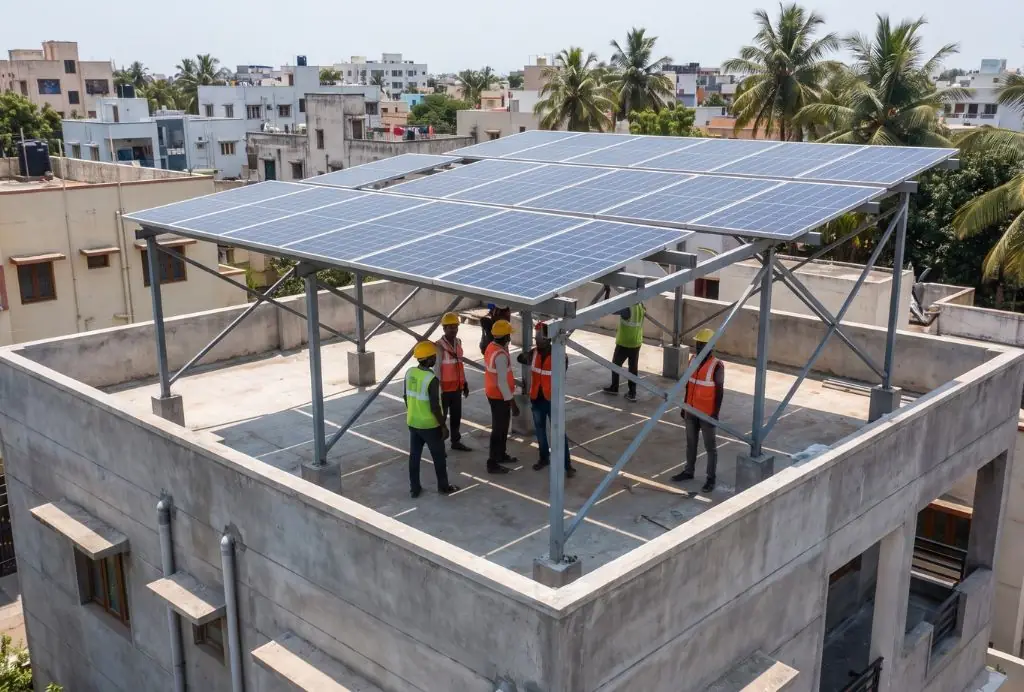
100 kW needs about 8,000 to 10,000 sq ft of shade-free roof and 170 to 180 panels, about 174 at 575 Wp. The roof type changes the price.
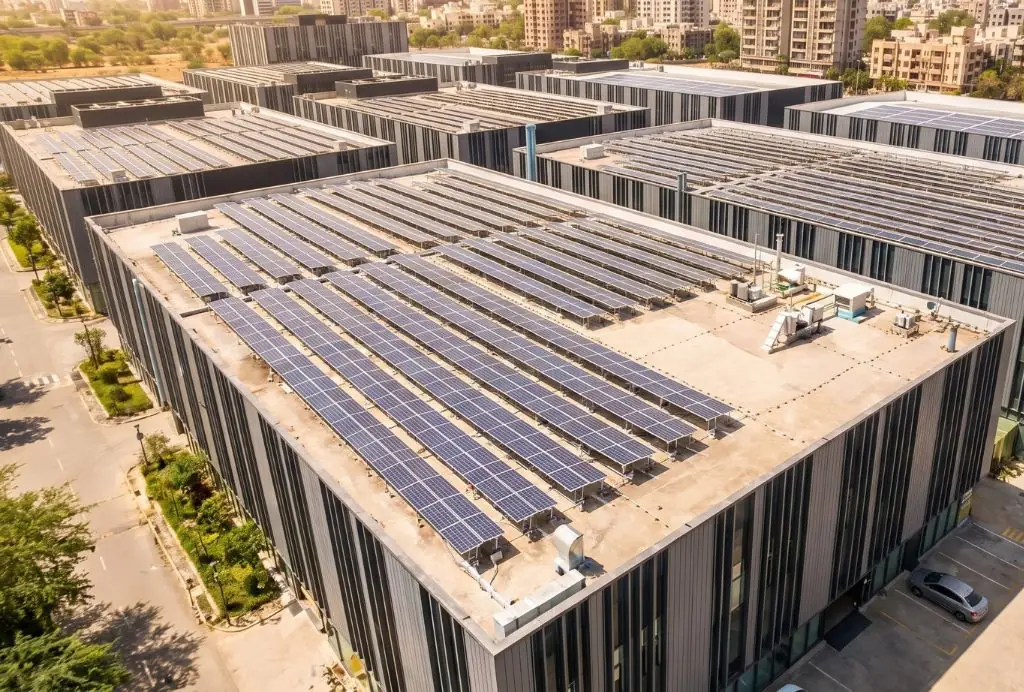
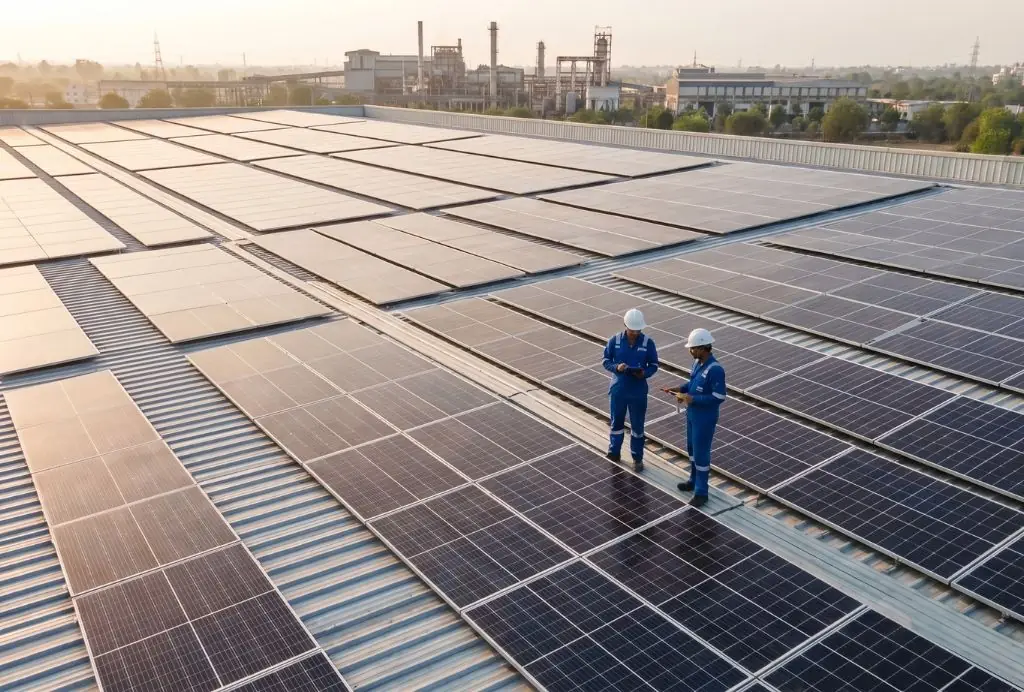
- Metal sheet sheds (factories, warehouses, godowns) are cheaper per kW because rails clamp to the sheet. Check purlins, sheet age and leaks; replace tired sheets first.
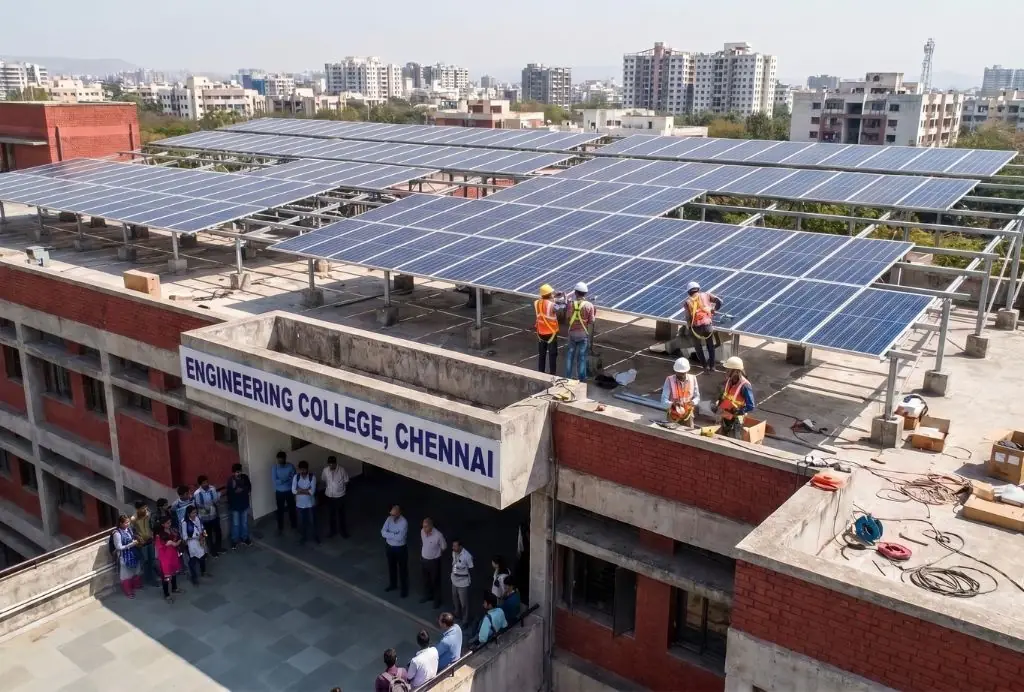
- RCC roofs (offices, hospitals, colleges) need an elevated frame and cleaning walkways: more steel, more labour.
- Two or more buildings. Each inverter set needs its own generation meter, which adds cost.
Is there a subsidy for a 100 kW plant?
Not for a business. PM Surya Ghar is a residential scheme, and Tamil Nadu has no capital subsidy for a business rooftop. A business recovers money in two other ways: the ₹3.4 to ₹3.8 lakh of GST as input credit, and 40% accelerated depreciation on the written-down value. A manufacturer can add 20% additional depreciation in year one, unless it has opted for the Section 115BAA tax regime.
These are deductions from taxable profit, not cash, so they need profit to set against; your CA should model them for the tax year. Our depreciation calculation guide shows later years. Housing societies are the exception: ₹18,000 per kW for common facilities, capped at 3 kW per house, so ₹18 lakh at 100 kW for a society of 34 houses or more. See solar for apartments.
Tamil Nadu rules at 100 kW
- Net feed-in only. On LT up to 150 kW, gross metering is not available. Imports are billed at your tariff and exports earn ₹3.37 a unit as money credit. Credit carries forward, and on 31 March you choose payment or carry-over. Our export unit price guide explains the tiers.
- Network charge on all generation. LT V commercial pays ₹1.60 a unit; LT IIIB industry pays ₹0.80 because the state pays half in 2026-27; HT pays ₹1.04. The charge is currently levied and under challenge in the Madras High Court; see our network charges guide.
- Size cap. The plant cannot exceed your sanctioned load or contracted demand, so 100 kW needs at least 100 kW sanctioned. Total solar on your distribution transformer is capped at 90% of its capacity, and a connection with arrears is not eligible. See our capacity limit guide.
- CEIG and metering. Electrical Inspectorate approval before commissioning, plus a separate generation meter.
- Fee and route. ₹900 registration, filed on the TNPDCL rooftop portal.
Payback worked on an LT V office and an LT IIIB factory
Annual saving = (units used on site × your tariff) + (units exported × ₹3.37) − (all units generated × network charge). Both buyers use 90% of their solar on site, typical for a daytime load. The office is on LT V at ₹10.45; the engineering unit is on LT IIIB at ₹8.25 with the reduced ₹0.80 network charge.
The factory saves less but, off Section 115BAA, deducts ₹24 lakh in year one against the office's ₹16 lakh, narrowing the after-tax gap.
Time of day. Early solar output covers part of the 6 to 10 am peak. The office pays the full 25% surcharge, about ₹13.06 a unit. The factory gets 2026-27 state relief: 15% with a smart meter (₹9.475 a unit), nothing without one. Neither is counted above.
What does not change. Fixed charges stay at ₹332 per kW a month on LT V and ₹165 on LT IIIB (demand above 50 to 112 kW). On HT I (₹7.50 a unit, ₹1.04 network charge) the same plant would save about ₹9.7 lakh a year, a 3.9 to 4.5 year payback; HT plants are covered on the 200 kW solar plant cost page.
75 kW or 150 kW: the transformer rule and the 150 kW LT ceiling
Size down to 75 kW (₹31.5 to ₹36 lakh including GST, 1,20,000 units a year, 6,000 to 7,500 sq ft, about 130 panels) when the roof is short or daytime use is nearer 10,000 units a month than 13,300. The 50 kW page covers smaller plants.
Size up to 150 kW (₹60 to ₹67.5 lakh including GST, 2,40,000 units a year, 12,000 to 15,000 sq ft, about 260 panels) only after checking your connection, because Tamil Nadu sets hard lines on LT supply:
- Up to 112 kW of demand, no transformer space is needed.
- Between 112 and 150 kW, the consumer must give free space, inside the premises or within 50 metres, for a TNPDCL distribution transformer. Demand is billed at ₹608 per kW a month and the consumer bears the transformer losses.
- 150 kW is the LT ceiling. Above it the connection must be HT. On HT, plants from 151 to 999 kW earn ₹3.10 a unit for exports, may choose gross metering, and pay a ₹5,000 registration fee.
So a business with 100 to 112 kW of load can install 100 kW clear of the transformer rule. Going to 150 kW means raising load past 112 kW, with the space, ₹608 fixed charge and losses that brings. Price those first.
CAPEX, loan or RESCO for 100 kW
CAPEX gives the full saving, depreciation and GST credit. A term loan spreads the outlay; set the office's average saving of about ₹1.08 lakh a month against the EMI. See our bank loan guide. RESCO or OPEX means a developer owns the plant and sells you the power per unit for an agreed term, with nothing upfront; the developer keeps the depreciation. It suits buyers who cannot use the tax benefit. Our CAPEX vs RESCO comparison shows how to weigh the unit rate against your tariff.
Build timeline: purchase order to commissioning
Registration to approval can take up to 20 working days under the regulations, about four weeks. Design and procurement run alongside. Plan the tie-in to your main LT panel, which needs a short shutdown, for a holiday or shift break. Our CEIG approval guide covers the inspection.
What a 100 kW quote must list
- AC capacity (inverter rating) and DC capacity (panel total), stated separately.
- Module and inverter make, model and count, and whether modules are DCR.
- Structure material, height and corrosion protection, with design calculations for wind.
- Cable sizes, earthing, lightning and surge protection, and the generation meter.
- TNPDCL registration, feasibility and CEIG liaison: included or extra.
- GST shown separately at the 8.9% composite rate.
- A yearly generation estimate near 1,600 units per kW in Chennai. Ask how any figure above about 1,700 was reached.
- Maintenance years included, and the AMC rate after them.
- Warranty terms for modules, inverters and workmanship, in writing.
- Payment stages tied to delivery, installation, CEIG approval and commissioning.
- Exclusions, especially roof repairs and sheet replacement.
A quote that covers all eleven can be compared like for like. Our solar EPC contractor page explains how Blues scopes this work.
Other commercial sizes
100 kW solar plants, common questions
What is the cost of a 100 kW solar plant in India in 2026?
In Chennai, a 100 kW rooftop plant costs ₹41 to ₹47 lakh installed, including 8.9% GST, or ₹37.6 to ₹43.2 lakh before GST. That is ₹41 to ₹47 a watt including tax.
How many units does a 100 kW solar plant generate per day?
About 440 units a day on average in Chennai, 13,300 a month and 1,60,000 a year, based on 1,600 units per kW a year.
How much roof area is required for a 100 kW solar plant?
About 8,000 to 10,000 sq ft of shade-free roof. A metal sheet shed uses the space more tightly than an RCC roof with tanks and lift rooms.
Is there a government subsidy for a 100 kW solar plant?
Not for a business. PM Surya Ghar is residential only. A business gets GST input credit and 40% accelerated depreciation, plus 20% additional depreciation for a manufacturer not on Section 115BAA. A housing society gets ₹18,000 per kW for common facilities.
What is the payback period of a 100 kW solar plant?
About 2.9 to 3.3 years for an LT V commercial building and 3.4 to 3.9 years for an LT IIIB factory, both using 90% of their solar on site, before counting depreciation.
Can a 100 kW solar plant run on an LT connection?
Yes. LT supply in Tamil Nadu goes up to 150 kW of demand. You need at least 100 kW of sanctioned load, and above 112 kW you must give space for a TNPDCL transformer.
How long does it take to install a 100 kW solar plant?
Registration to TNPDCL approval can take up to 20 working days, then CEIG approval comes before commissioning. Installation runs alongside on contract dates.
Do I need DCR panels for a 100 kW commercial plant?
No. DCR modules cost ₹23 to ₹26 a watt against ₹14.3 to ₹14.9 for non-DCR, about ₹8 to ₹11 lakh more at 100 kW, and no business subsidy requires them.
Get a 100 kW proposal for your premises
Send your last few electricity bills, your sanctioned load and a roof drawing or photos. We will tell you whether 75, 100 or 150 kW fits your connection, and send an itemised quote with every line above priced and a payback worked on your own tariff.
An engineer calls back within one working day. We use your bill only to size the system and never pass your details on.
Sources
Blues Renewables price bands for Chennai rooftop installations, October 2026: installed prices for 75, 100 and 150 kW.
TNERC, Suo-motu Tariff Order No. 6 of 2025, 30 June 2025, effective 1 July 2025: LT V ₹10.45 and LT IIIB ₹8.25 energy charges and fixed charges, HT I ₹7.50 per kWh, time-of-day surcharge, network charges of ₹1.60 (LT) and ₹1.04 (HT) a unit.
TNERC Order No. 4 of 2026, 27 April 2026, Provisional Tariff Subsidy Order FY 2026-27: LT IIIB network charge paid at ₹0.80 after the 50% state subsidy, and LT IIIB peak surcharge of 15% with a smart meter and nil without.
TNERC, Grid Interactive Solar PV Energy Generating System Regulations 2021, notified 7 October 2021, and TNERC Order No. 8 of 2021, 22 October 2021: net feed-in, ₹3.37 and ₹3.10 feed-in tariffs, gross metering for 151 to 999 kW, AC-side capacity, sanctioned-load and transformer caps, generation and check meters, feasibility and approval timelines, payment terms, registration fees.
Tamil Nadu Electricity Distribution Code, Regulation 26(1)(b), substituted by TNERC Notification TNERC/DC/8-26 of 9 June 2020 (consolidated to 31 March 2024): LT supply up to 150 kW demand and transformer space from 112 to 150 kW.
Ministry of Power, Electricity (Rights of Consumers) Amendment Rules 2024, 22 February 2024: feasibility study within 15 days above 10 kW, else deemed feasible.
Energy Department, Government of Tamil Nadu, G.O.Ms. No. 98, 14 October 2024: CEIG approval for generating units above 10 kVA.
CBIC Notification No. 9/2025-Central Tax (Rate), 17 September 2025, in force 22 September 2025: 5% GST on solar power devices; the 70:30 rule gives 8.9% on turnkey contracts.
Income-tax Act 1961, Sections 32(1)(ii), 32(1)(iia) and 115BAA, with Appendix I of the Income-tax Rules 1962: 40% depreciation for solar power generating systems, the 180-day rule, 20% additional depreciation for manufacturers; Income-tax Act 2025 (from 1 April 2026), Sections 33 and 200, carrying the same rules into the tax year.
JMK Research, module price report Q4 2025: non-DCR modules at ₹14.32 and ₹14.88 per Wp; DCR modules about ₹23 to ₹26 per W as reported by IEEFA, late 2025.
Madras High Court, South India Spinners Association v. CMD TANGEDCO, order of 22 December 2024, stayed in part on writ appeal on 28 April 2025: the challenge to rooftop solar network charges.