




Home / Commercial solar / 200 kW solar plant cost
Commercial solar · 200 kW200 kW Solar Plant Cost in Tamil Nadu
A 200 kW rooftop solar plant costs ₹78 to ₹88 lakh installed in Chennai in 2026, including 8.9% GST, which is ₹39 to ₹44 a watt. A GST-registered business that claims the tax back pays ₹71.6 to ₹80.8 lakh, and the plant makes about 3,20,000 units a year.
200 kW is the first size that cannot sit on an LT connection in Tamil Nadu. Above 150 kW you are an HT consumer, so four things change at once: the export rate drops to ₹3.10, gross metering becomes an option, the network charge falls to ₹1.04 a unit and the registration fee rises to ₹5,000. This page prices 200 and 250 kW, works the payback on an HT I factory bill and an HT III commercial bill, and shows when gross metering beats net feed-in.
Get an itemised proposalCall +91 98841 07170200 kW at a glance
- Installed price₹78 to 88 lakh
- Before GST₹71.6 to 80.8 lakh
- Units a yearabout 3,20,000
- Roof needed16,000 to 20,000 sq ft
- Panelsabout 335 to 365
- Export rate₹3.10 a unit
Chennai district yield of 1,600 units per kW a year, 550 to 600 Wp modules, and the TNERC feed-in band for 151 to 999 kW.
200 kW and 250 kW solar plant prices in 2026
These are Blues's published bands for a turnkey, on-grid rooftop plant in Chennai. The incl-GST column is the cost for a buyer that cannot claim input credit. A GST-registered factory or office gets the tax back, so its real cost is the ex-GST column. The 8.9% rate comes from the 70:30 rule: 70% of the contract is valued as goods at 5% and 30% as service at 18%.
For a smaller plant on an LT service, see the 100 kW page; for factory-scale plants, the 500 kW page. Every size from 10 kW to 1 MW is on the commercial solar cost per kW table.
Where the ₹85 lakh goes in a 200 kW plant
The price covers everything up to a commissioned, metered plant:
- Modules: about 335 to 365 panels of 550 to 600 Wp. Non-DCR modules cost about ₹14.3 to ₹14.9 a watt ex-works (JMK Research, Q4 2025), so roughly ₹28.6 to ₹29.8 lakh of modules at this size.
- Inverters: sized to the AC capacity, which is the figure TNPDCL approves and counts.
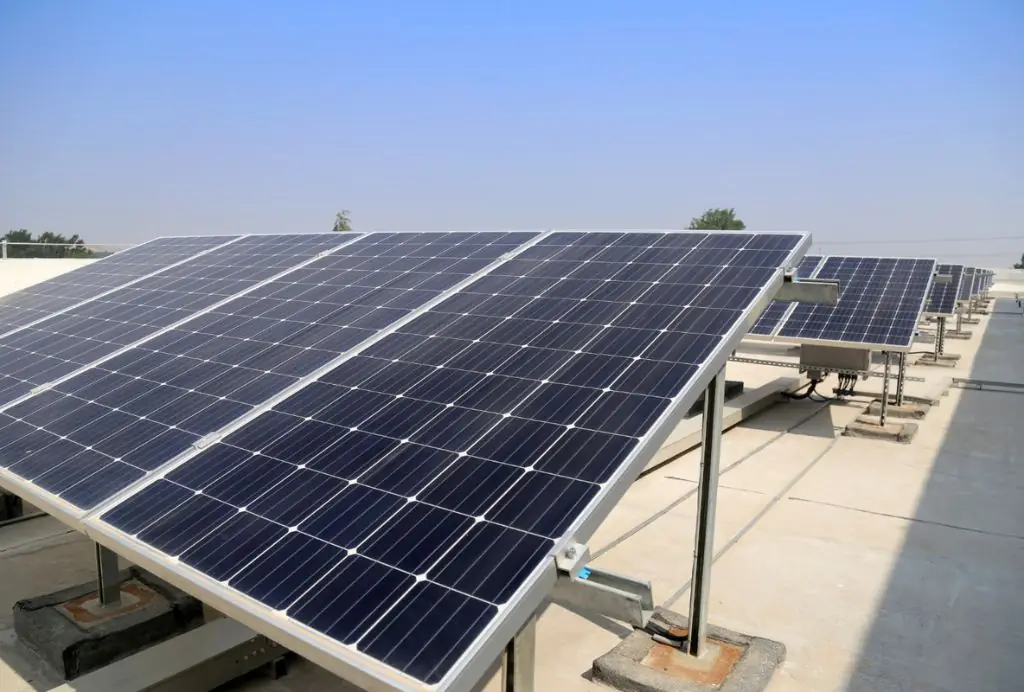
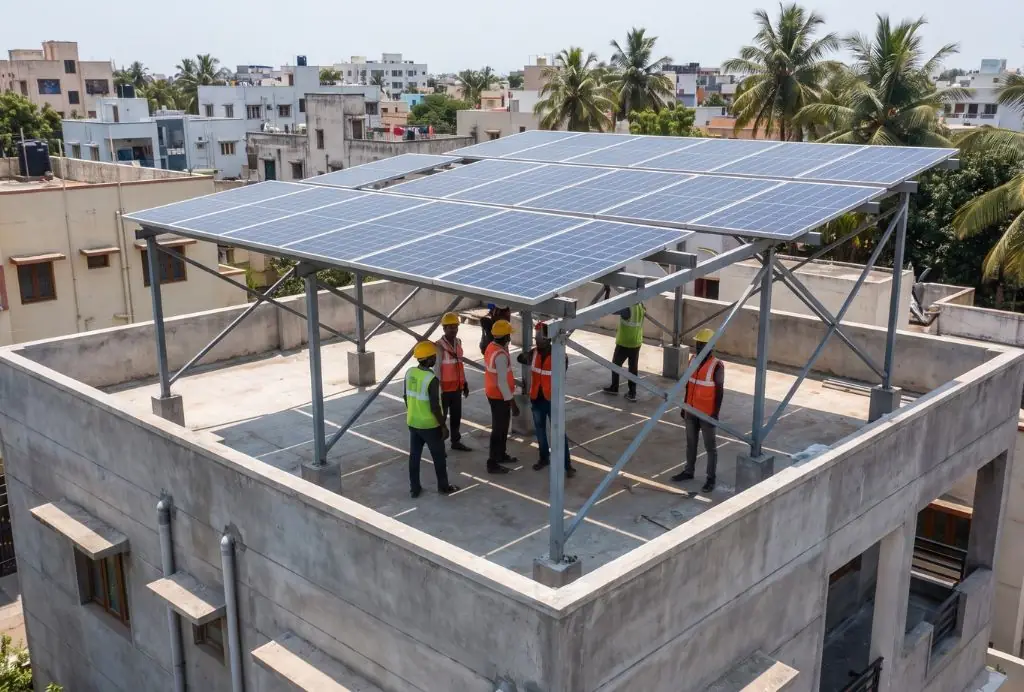
- Mounting structure: rails fixed to the purlins on a metal sheet roof, or an elevated galvanised frame on RCC.
- Cabling and protection: DC and AC cabling, combiner boxes, the AC panel and tie-in, earthing and lightning protection.
- Metering and approvals: a generation meter with demand recording, CEIG approval and TNPDCL liaison for the HT application.
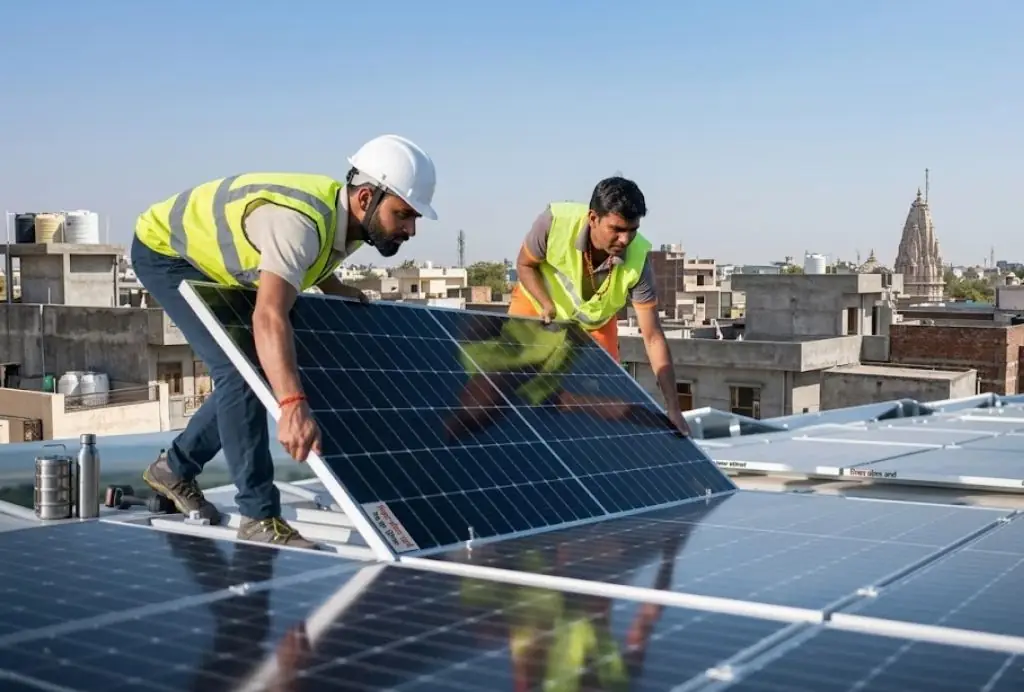
- Labour and care: installation by our own crews, commissioning, and two years of maintenance.
What moves the price at 200 kW
- Roof type: a metal sheet roof costs less per kW than RCC, which needs an elevated structure.
- DCR or non-DCR modules: DCR modules at about ₹23 to ₹26 a watt add ₹8 to ₹11 a watt, or ₹16 to ₹22 lakh at 200 kW. Businesses buy non-DCR because no subsidy asks them for DCR.
- HT-side equipment: above 150 kW the interconnection, protection and metering suit an HT service, which costs more than an LT tie-in.
- Inverter brand, structure height, cable runs, and any roof repair done first.
How many units 200 kW makes, and the roof it needs
In Chennai each kW makes about 1,600 units a year, about 4.4 a day. A 200 kW plant therefore makes about 3,20,000 units a year, about 26,700 a month and about 880 on an average day. Other Tamil Nadu districts sit between 1,550 and 1,700 units per kW, so the same plant makes 3,10,000 to 3,40,000 units depending on where it stands. Output falls by about half a percent a year as the panels age.
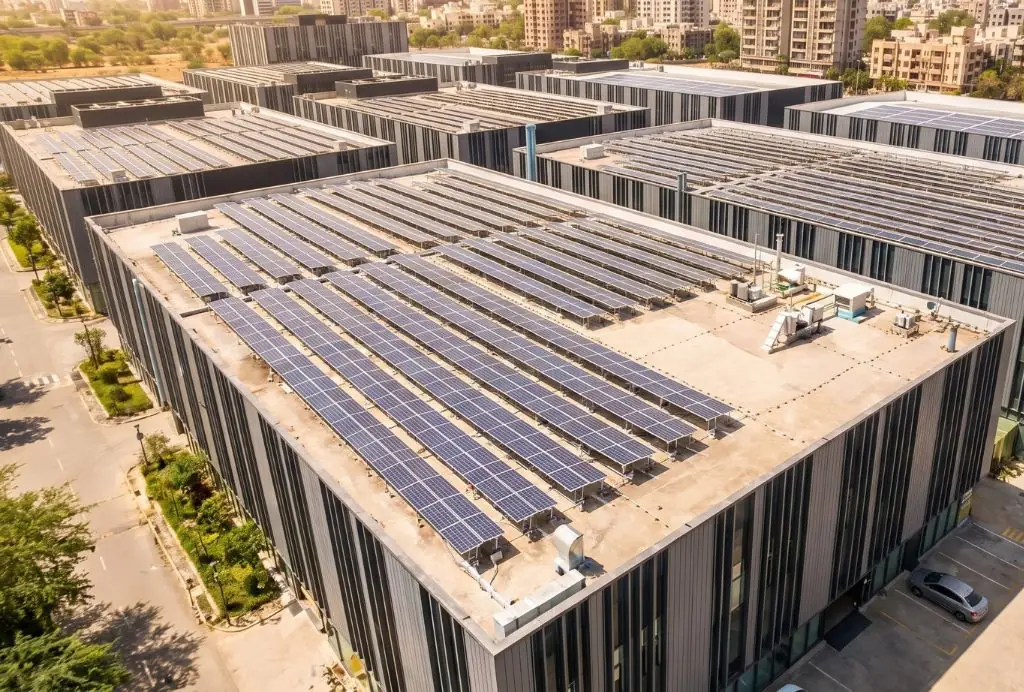
Allow 80 to 100 sq ft of shade-free roof per kW, which means 16,000 to 20,000 sq ft for 200 kW. Several buildings can feed one plant, but each inverter set on a separate building needs its own generation meter.
Crossing 150 kW: what changes in Tamil Nadu
Tamil Nadu's LT supply stops at 150 kW of demand (Distribution Code Reg 26). Your solar capacity cannot exceed your sanctioned load or contracted demand, so a 200 kW plant needs an HT service whose contracted demand covers it. That changes the rules below.
Some rules stay the same. Above 10 kW you still need CEIG approval before commissioning, plus a separate generation meter. TNPDCL runs a technical feasibility study within 15 working days of registration and approves within 5 working days after that. The cap is your contracted demand or 999 kW, whichever is lower; the capacity limit guide explains how TNPDCL reads it.
The ₹1.04 network charge applies to every unit the generation meter records. It is currently levied and under legal challenge in the Madras High Court; our network charges guide follows the case. Every figure here includes it.
Net feed-in or gross metering at 200 kW
Under net feed-in, units used on site cut your bill at your full tariff and only the surplus earns ₹3.10. Under gross metering, TNPDCL takes every unit at ₹3.10, you buy all your power at your tariff, and no network charge applies. For an HT I factory using 90% of its generation:
Net feed-in is worth almost twice as much. A unit used on site nets ₹6.46 after the network charge (₹7.50 minus ₹1.04); a gross-metered unit earns ₹3.10. Gross metering only wins below about 24% self-use on HT I, or about 17% on HT III: a big roof with almost no daytime load. The net metering vs net feed-in guide and the export unit price post cover settlement: credit carries forward, and on 31 March you choose payment or carry-over.
Payback for a factory on HT I and an office on HT III
Annual saving = self-consumed units × your energy tariff, plus exported units × ₹3.10, minus total generation × ₹1.04. Solar cuts the energy charge only. The demand charge stays where it was.
HT I factory using 90% of its solar
A factory on HT I pays ₹7.50 a unit. Assume its daytime load stays above the plant output on working days, so it uses 90% of the generation.
The table leaves out the morning peak. HT energy costs 25% more from 6 to 10 am, ₹9.375 instead of ₹7.50, and solar covers part of that window, so each self-used unit inside it saves ₹1.875 more than counted here.
It also leaves the demand charge alone. HT I pays ₹608 per kVA a month on the higher of recorded demand or 90% of contracted demand. A factory with 300 kVA contracted demand pays at least 270 × ₹608 = ₹1,64,160 a month, about ₹19.7 lakh a year, and solar does not reduce it: demand is measured in 15-minute blocks, and one cloudy block at full load sets the same peak.
HT III office or mall using 85% of its solar
An office block, mall or hotel on HT III pays ₹9.40 a unit. Assume 85% self-use, since weekends and holidays send more units to the grid.
A business with taxable profit also claims 40% accelerated depreciation: about ₹30.4 lakh of deduction in year one on a ₹76 lakh plant, halved if it runs under 180 days that year. Manufacturers add 20% more, unless on Section 115BAA. Your CA should model it. Test your own bill on the commercial solar ROI calculator.
Hospital, school trust or apartment association at 200 kW: CAPEX or RESCO
Three kinds of buyer at this size do not fit the factory maths, because they cannot use the GST credit, the depreciation, or both.
Private hospital
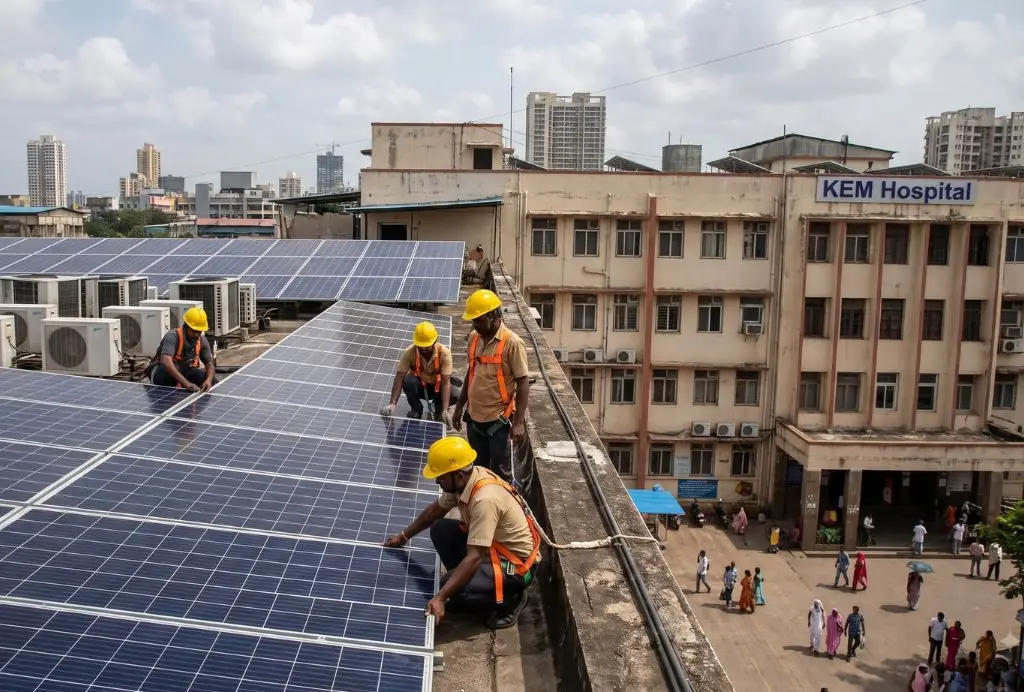
A private hospital on HT III pays ₹9.40 a unit and runs around the clock, so it uses nearly every unit. If it cannot claim input credit, its cost is ₹78 to ₹88 lakh. At 95% self-use it saves about ₹25.7 lakh a year (3,04,000 × ₹9.40, plus 16,000 × ₹3.10, minus ₹3,32,800), so CAPEX pays back in about 3 to 3.4 years. See solar for hospitals.
School or college trust
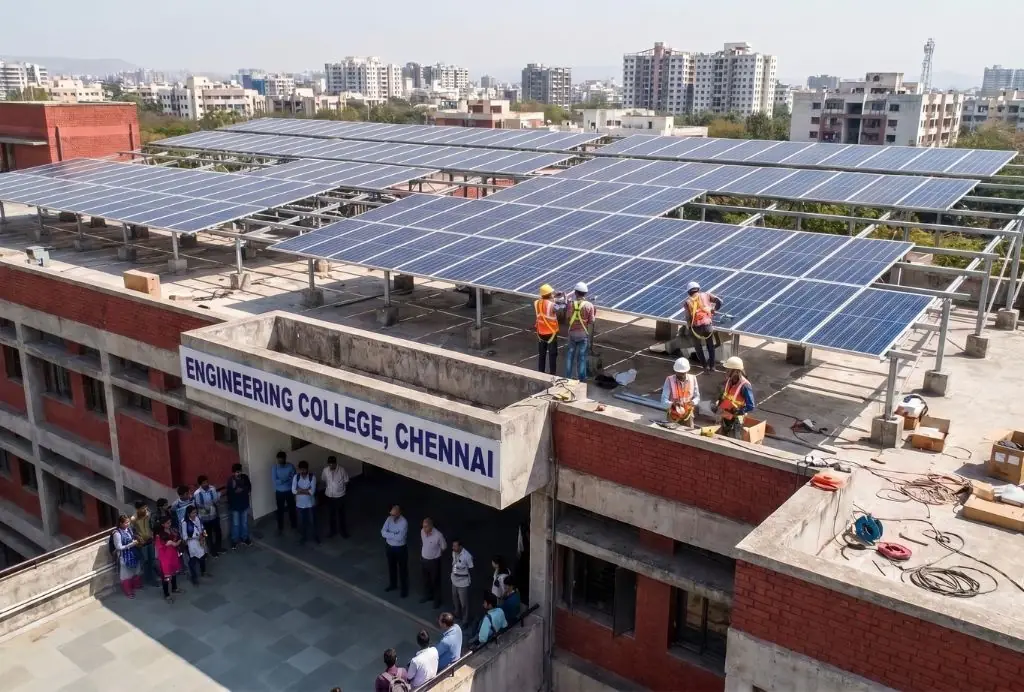
A private school or college on HT pays ₹8.25 a unit (HT IIB). A trust with no taxable profit gets nothing from depreciation, and holidays lower self-use. That makes RESCO worth pricing: a developer owns the plant and you pay only for units at an agreed tariff, with nothing up front. CAPEX keeps the whole saving with the trust. See solar for schools and colleges.
Apartment association
Housing societies and RWAs are the one buyer at this size with a central subsidy: ₹18,000 per kW for common facilities, up to 500 kW, capped at 3 kW per house. A 200 kW common-area plant needs at least 67 houses to qualify in full and would receive ₹36 lakh. See solar for apartments, and the full trade-off on CAPEX vs OPEX vs RESCO.
Build timeline for a 200 kW HT plant
Approvals set the pace more than installation does, so every proposal carries a dated schedule:
- Site survey, shade and structure check, then the final design and bill of materials.
- HT application to TNPDCL with the ₹5,000 fee.
- Technical feasibility study within 15 working days of registration, then approval within 5 working days, valid for six months.
- Procurement and installation by our own crews. We plan the tie-in to your main panel for a holiday or shift break, so the building keeps power through working hours.
- CEIG inspection and approval before the plant is switched on.
- Generation meter fitting, synchronisation and commissioning.
250 kW: the same rules on a bigger roof
250 kW sits in the same band as 200 kW: HT, ₹3.10 export, ₹1.04 network charge, ₹5,000 fee, gross metering optional. What changes is the roof, 20,000 to 25,000 sq ft, and a contracted demand that must cover 250 kW.
At 250 kW on HT I with 90% self-use: 3,60,000 × ₹7.50 = ₹27,00,000, plus 40,000 × ₹3.10 = ₹1,24,000, minus 4,00,000 × ₹1.04 = ₹4,16,000. That is about ₹24.1 lakh a year, and the payback stays at 3.7 to 4.2 years.
Go to 250 kW only if your daytime load stays above the plant output: an extra unit used on site nets ₹6.46, an extra unit exported nets ₹2.06 (₹3.10 minus ₹1.04). Past 250 kW, the 500 kW page covers 300 and 400 kW.
Other commercial sizes
200 kW solar plants, common questions
How much does a 200 kW solar plant cost in 2026?
In Chennai, ₹78 to ₹88 lakh installed, including 8.9% GST, which is ₹39 to ₹44 a watt. Before GST it is ₹71.6 to ₹80.8 lakh, the real cost for a business that claims input credit.
How many units does a 200 kW solar plant generate per day?
About 880 units on an average day in Chennai, at 1,600 units per kW a year. That is about 26,700 units a month and 3,20,000 a year.
How much roof space does a 200 kW solar system need?
16,000 to 20,000 sq ft of shade-free roof, at 80 to 100 sq ft per kW. That holds about 335 to 365 panels of 550 to 600 Wp.
Can I install a 200 kW solar plant on an LT connection?
No. LT supply in Tamil Nadu stops at 150 kW, and solar cannot exceed your contracted demand, so 200 kW needs an HT service.
What export rate does a 200 kW plant get in Tamil Nadu?
₹3.10 a unit, the feed-in rate for 151 to 999 kW. The credit is paid in money, carries forward, and on 31 March you choose payment or carry-over.
Should a 200 kW plant use gross metering or net feed-in?
Net feed-in, for almost every business: a unit used on site nets ₹6.46 on HT I, against ₹3.10 gross. Gross metering only pays more if you would use under about 24% of the output yourself (about 17% on HT III).
Does solar reduce the HT demand charge?
No. Solar cuts the energy charge only. The ₹608 per kVA monthly demand charge is billed on the higher of recorded demand or 90% of contracted demand.
Is there a subsidy for a 200 kW commercial solar plant?
Not for a business, hospital or school. Housing societies and RWAs get ₹18,000 per kW for common facilities up to 500 kW, capped at 3 kW per house. A profitable business gets 40% depreciation and GST credit instead.
What is the payback period of a 200 kW solar plant?
About 3.7 to 4.2 years before depreciation for a factory on HT I using 90% of its solar, and about 3 to 3.4 years for an HT III office using 85%. Both figures count the ₹1.04 network charge.
Get a 200 kW proposal for your premises
Send your last two HT bills and a rough roof area. An engineer from our Guindy office checks the structure and your contracted demand, then sends an itemised proposal with the net feed-in arithmetic worked on your own tariff.
Our own crews install the plant, and the first two years of maintenance are included.
An engineer calls back within one working day. We use your bill only to size the system and never pass your details on.
Sources
Blues Renewables price bands for Chennai rooftop installations, October 2026: 150, 200, 250 and 300 kW prices.
TNERC Suo-motu Tariff Order No. 6 of 2025, 30 June 2025, effective 1 July 2025: HT I ₹7.50/kWh, HT III ₹9.40/kWh, HT IIB ₹8.25/kWh, ₹608/kVA demand charge, billable demand rule, 25% peak surcharge 6 to 10 am and 6 to 10 pm, HT network charge ₹1.04/kWh.
TNERC Grid Interactive Solar PV Energy Generating System Regulations 2021 (notified 7 Oct 2021) and TNERC Order No. 8 of 2021 (22 Oct 2021), with the TANGEDCO Technical Branch salient features of Order 8/2021: net feed-in, gross metering at 151 to 999 kW, feed-in ₹3.10 and ₹3.37, capacity cap, generation meter, registration fees, feasibility timelines, 31 March settlement.
Tamil Nadu Electricity Distribution Code Reg 26(1)(b), substituted by TNERC Notification TNERC/DC/8-26, 9 June 2020: LT supply up to 150 kW demand.
CBIC Notification No. 9/2025-Central Tax (Rate), 17 Sept 2025, in force 22 Sept 2025: 5% GST on solar devices; 70:30 valuation, giving 8.9% on turnkey EPC.
Income-tax Act 1961 Section 32 and Appendix I, Income-tax Rules 1962: 40% depreciation on solar power generating systems, half rate under 180 days, additional depreciation under Section 32(1)(iia), denied under Section 115BAA(2)(ii).
MoP Electricity (Rights of Consumers) Amendment Rules 2024, 22 Feb 2024: feasibility study within 15 days above 10 kW.
G.O.Ms. No. 98, Energy Department, 14 Oct 2024: CEIG approval for generating units above 10 kVA.
Madras High Court, South India Spinners Association v. CMD TANGEDCO, single judge order 22 Dec 2024 and division bench stay 28 Apr 2025: network charges under challenge.
JMK Research, Q4 2025 module price report: non-DCR modules ₹14.32/Wp (mono PERC) and ₹14.88/Wp (TOPCon); DCR modules about ₹23 to ₹26/W.
MNRE, PM Surya Ghar: Muft Bijli Yojana: ₹18,000 per kW for housing society and RWA common facilities up to 500 kW, 3 kW per house.