

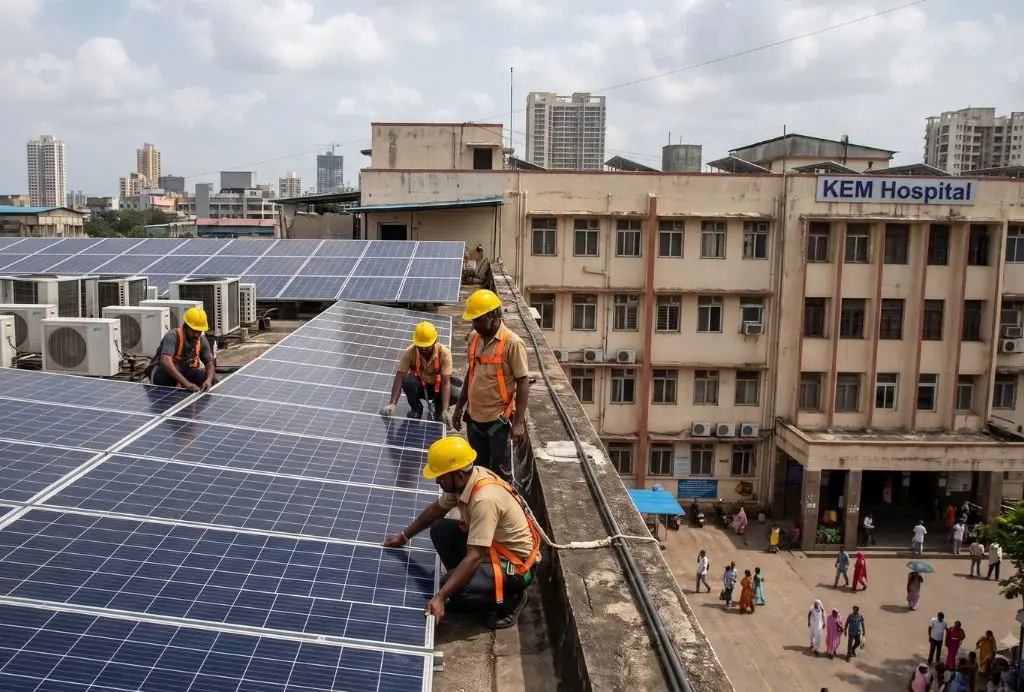

Solar EPC Company in Tamil Nadu for Factories and Businesses
Blues Renewables designs, supplies, installs and commissions commercial and industrial solar across Tamil Nadu, from a 15 kW shop roof to a factory plant of several hundred kilowatts, and handles the TNPDCL and Electrical Inspectorate approvals along the way.
Most of the state's industry sits in a few belts: the SIPCOT parks around Sriperumbudur, Oragadam and Irungattukottai, the Hosur and Krishnagiri corridor, Coimbatore and the Kongu belt, and the TANSIDCO estates in and around Chennai. The tariff rules are the same everywhere in Tamil Nadu. What changes from site to site is the tariff category, the roof and the daytime load, and those decide whether rooftop or open access makes sense.
Get an itemised proposalWhat decides the answer here
- The tariff category decides the saving. LT IIIB industry pays ₹8.25 a unit and only ₹0.80 network charge; HT I industry ₹7.50 and ₹1.04; HT III commercial ₹9.40; LT V commercial ₹10.45.
- Rooftop suits most sites. Green energy open access starts at 63 kVA on HT supply and carries cross subsidy surcharge and wheeling charges, so it is for large consumers.
- Exports earn far less than self-use. ₹3.37 a unit for 11 to 150 kW and ₹3.10 for 151 to 999 kW, against ₹7.50 to ₹10.45 for a unit used on site.
- LT supply runs up to 150 kW, and plants above 10 kW need Electrical Inspectorate approval.
- No capital subsidy for business. 40 percent accelerated depreciation and GST input credit apply instead.
Where we work in Tamil Nadu
We take on commercial and industrial rooftops across the state, with most of our work in these belts:
- Chennai and its industrial estates: Guindy, Ambattur, Thirumazhisai, Maraimalainagar, Thirumudivakkam and the OMR office corridor.
- The Kancheepuram and Tiruvallur SIPCOT parks: Sriperumbudur, Oragadam, Irungattukottai, Pillaipakkam, Gummidipoondi and Mappedu.
- Hosur and Krishnagiri: SIPCOT Hosur, Shoolagiri and Bargur.
- Coimbatore and the Kongu belt: Kurichi, Malumichampatti, the Sulur parks, Tiruppur and Perundurai. See our page on commercial solar in Coimbatore.
- Ranipet, Tiruchirappalli, Madurai and the south, sized on a site survey.
SIPCOT runs around 50 industrial parks across 24 districts and TANSIDCO 141 industrial estates, so most factories in the state sit on a planned estate with sheet-roof sheds that suit solar well.
Tariffs by category, and what each unit of solar saves
Every unit used on site saves the energy charge less the network charge. Every unit exported earns the net feed-in rate, ₹3.37 for 11 to 150 kW or ₹3.10 for 151 to 999 kW, less the same network charge. That gap is why a plant sized to the daytime load pays back in three to four years and one sized to the roof can take much longer.
Rooftop or open access?
Large consumers can buy or wheel green power under TNERC's Green Energy Open Access Regulations 2025, notified on 18 September 2025.
- Eligibility: HT and EHT consumers with a contracted demand of 63 kVA and above. LT consumers cannot use it.
- Charges: cross subsidy surcharge of ₹1.99 a unit for HT I and ₹2.57 for HT III, plus ₹1.04 wheeling, besides transmission, scheduling and other charges.
- Banking: settled within the calendar month, with 8 percent of banked energy kept as the charge; unused banked energy is bought at 75 percent of the applicable tariff.
- Captive and group captive: users must own at least 26 percent and consume at least 51 percent of the generation; the central rules were revised in March 2026. Our guides to open access solar and group captive explain both.
For most factories and offices the roof is the simpler and cheaper route: no surcharges, no scheduling, and the power is used where it is made. Open access starts to make sense when the load runs to several megawatts or the roof cannot carry enough capacity.
What an industrial plant earns
Worked on the published tariffs, with 90 percent of generation used on site and 1,600 units per kW a year. Prices are 2026 bands including GST; payback is on the ex-GST price, before depreciation. See commercial solar cost per kW for every size.
How a commercial project runs
- Bills and survey. Twelve months of bills, the sanctioned load and a site visit to measure the roof, check the structure and map shading.
- Design and proposal. Size to the daytime load, an itemised proposal with module and inverter makes, a generation estimate and the payback.
- Approvals. The TNPDCL rooftop application and, above 10 kW, Electrical Inspectorate drawing approval and safety certificate.
- Installation and commissioning. Structure, modules, inverters, protection and earthing, then TNPDCL inspection, the net feed-in meter and commissioning.
- After commissioning. Monitoring, cleaning and maintenance. Our guide to appointing an EPC contractor lists what the contract should cover.
The tax side
No capital subsidy applies to a business; PM Surya Ghar is residential only. Solar power generating systems depreciate at 40 percent a year under the Income-tax Rules 2026, and a manufacturer can add 20 percent additional depreciation unless it opted for the 22 percent regime. GST on a turnkey contract works out near 8.9 percent, creditable for a registered business. Small manufacturers should also see our page on solar for MSMEs in Tamil Nadu.
Frequently asked questions
Which is the best solar EPC company in Tamil Nadu for a factory?
Choose on evidence: commissioned commercial plants you can visit, MNRE and TNPDCL registration, an itemised proposal with named module and inverter makes, a generation guarantee, and who handles the Electrical Inspectorate approval. Blues Renewables designs, installs and commissions commercial and industrial plants across Tamil Nadu and handles the approvals.
Is there a subsidy for commercial solar in Tamil Nadu?
No capital subsidy. PM Surya Ghar and the state top-up are for households. Businesses get 40 percent accelerated depreciation and GST input credit, and LT IIIB industrial consumers pay half the rooftop network charge, ₹0.80 a unit.
Who can use open access solar in Tamil Nadu?
HT and EHT consumers with a contracted demand of 63 kVA and above, under TNERC's Green Energy Open Access Regulations 2025. It carries cross subsidy surcharge (₹1.99 a unit for HT I, ₹2.57 for HT III) and wheeling charges, so rooftop is usually simpler for smaller sites.
How much does a 100 kW industrial solar plant cost in Tamil Nadu?
About ₹41 to ₹47 lakh including GST in 2026. On an LT IIIB factory using 90 percent of its solar it saves about ₹11.1 lakh a year, a payback of about 3.4 to 3.9 years before depreciation.
Do commercial solar plants need CEIG approval in Tamil Nadu?
Plants above 10 kW need Electrical Inspectorate approval, a two-stage online process of drawing approval followed by a safety certificate, alongside the TNPDCL rooftop application.
Send twelve bills and your site location
Twelve months of bills, the tariff category, the sanctioned load, the site location and a photograph of the roof are enough for a first sizing and payback.
We will tell you whether rooftop, open access or both suit the site, and what each would earn. Chennai sites can also see our solar EPC company in Chennai page.
Call +91 98841 07170Sources
TNERC, Suo-motu Tariff Order No. 6 of 2025, 30 June 2025: tariffs, network charges, cross subsidy surcharge
TNERC, Order No. 4 of 2026, 27 April 2026: ₹0.80 network charge for LT IIIB
TNERC, Green Energy Open Access Regulations 2025 (TNERC/GEOA/25-1/2025, 18 September 2025), Regulations 12, 13, 15 and 16
Powerline, 15 June 2026: revised captive power rules (26 percent ownership, 51 percent consumption)
SIPCOT, industrial parks list (accessed 21 October 2026); TANSIDCO, industrial estates list (accessed 21 October 2026)
Electrical Inspectorate, Government of Tamil Nadu: approval of solar PV plants above 10 kW
Income-tax Rules 2026, Appendix I item 8(xiii); Income-tax Act 2025, sections 33 and 200; CBIC Notification No. 9/2025-Central Tax (Rate)