

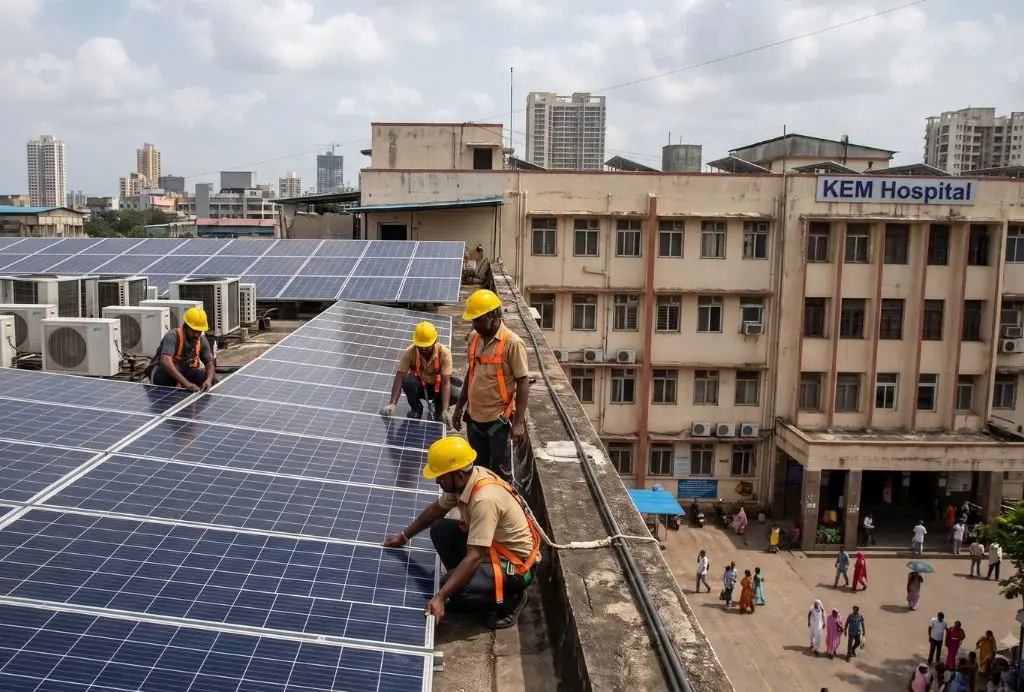

Solar for MSMEs in Tamil Nadu: Subsidy, Loans and Payback
Most MSME owners start with one question: is there a solar subsidy for my unit? In 2026 the honest answer is no capital subsidy, from the Centre or from Tamil Nadu. What there is matters more to the payback than a one-time grant would.
A small factory on the LT IIIB tariff pays only half the rooftop solar network charge, because the state pays the other half. Banks lend for captive solar with long tenures, collateral-free up to ₹20 lakh for micro and small units, and the plant depreciates at 40 percent a year. This page sets out each of those, with the sources, and what a 50 kW plant actually earns.
Get an itemised proposalWhat decides the answer here
- No capital subsidy for MSME rooftop solar in 2026. PM Surya Ghar is for households, MNRE excludes commercial and industrial consumers, and the MSE-GIFT interest subvention closed for loans sanctioned after 31 March 2026.
- LT IIIB units pay ₹0.80 a unit network charge, not ₹1.60. The Tamil Nadu government pays the other half. HT industry (₹1.04) and LT V commercial (₹1.60) pay in full.
- Finance is easy to get. SBI Surya Shakti lends up to ₹10 crore over 10 years; Indian Bank IND-SURYA SHAKTI has no ceiling and runs 15 years; CGTMSE guarantees MSE loans up to ₹10 crore.
- Tax does the work a subsidy would. 40 percent depreciation, plus 20 percent additional depreciation for manufacturers outside the 22 percent regime, and GST input credit for a registered manufacturer.
- Size to daytime load, not roof area. Exported units earn ₹3.37, under half the ₹8.25 an LT IIIB unit pays, and capacity is capped at your sanctioned load.
Is there a solar subsidy for MSMEs in 2026?
Not a capital subsidy. Three facts settle it.
- PM Surya Ghar: Muft Bijli Yojana is a household scheme. The ₹78,000 and the Tamil Nadu top-up of up to ₹22,000 are for domestic connections only. A proposal that deducts them from a factory quotation is deducting money the business will never receive.
- MNRE excludes commercial and industrial consumers. The rooftop programme guidelines say central financial assistance is not available for commercial and industrial sectors, because these consumers pay high tariffs and recover the cost without it.
- MSE-GIFT has closed. This RAMP sub-scheme paid a 2 percent interest subvention on micro and small enterprise loans that included solar, but only on loans sanctioned up to 31 March 2026. No extension has been announced.
What the Tamil Nadu MSME Policy 2021 offers, and the catch
The policy (G.O. (Ms) No. 11, 16 February 2021) has an additional capital subsidy of 25 percent, up to ₹10 lakh, for cleaner and environment-friendly technology, and the PEACE scheme pays 50 percent, up to ₹10 lakh, for equipment replaced to improve energy efficiency in existing manufacturing units.
Neither names rooftop solar, and we found no official list that counts it. Both are for manufacturing units, service enterprises are excluded, and the capital subsidies apply to new units or a substantial expansion. If your unit might qualify, ask your District Industries Centre before you sign, and treat any approval as a bonus rather than part of the payback.
The benefit that is real: half the network charge
Every rooftop solar consumer in Tamil Nadu pays a network charge on the units the plant generates. Under TNERC Tariff Order 6 of 2025 it is ₹1.60 a unit on LT and ₹1.04 on HT.
For LT IIIB, the industrial LT category up to 150 kW of contracted demand, the state government pays half. LT IIIB units therefore pay ₹0.80 a unit, a concession TNERC carried into FY 2026-27 in its Order No. 4 of 2026.
The concession follows the tariff category, not Udyam registration. An MSME on HT supply, or a service business on LT V, pays the full charge. The network charge itself is under challenge in the Madras High Court, where a 2025 stay keeps it billable for now.
Solar loans for MSMEs
Banks treat a captive solar plant as an ordinary term loan with an unusually reliable source of repayment: the units it saves. These are the published terms; rates are linked to each bank's benchmark and quoted on application. Our guide to bank loans for solar plants covers the paperwork.
SBI asks for a "net metering arrangement". Tamil Nadu gives industrial and commercial consumers net feed-in rather than net metering, so confirm with the branch that net feed-in satisfies the condition before you apply. SIDBI also finances MSME rooftop solar through its 4E energy-efficiency scheme; ask SIDBI for its current terms, which officials have described differently in 2025 and 2026.
If you would rather not borrow at all, the OPEX model lets a developer own the plant and sell you the power at a fixed rate.
Tax: depreciation and GST
Solar power generating systems sit in the 40 percent block for accelerated depreciation under Appendix I of the Income-tax Rules 2026. A plant put to use for less than 180 days in the tax year gets half, 20 percent, in year one, with the balance carried forward. Our guide to how to calculate it works through an invoice.
- Manufacturers get 20 percent more. New plant and machinery used in manufacture qualifies for additional depreciation of 20 percent of cost, so a manufacturing MSME can claim 40 plus 20 percent in year one. Traders, offices and other service businesses get the 40 percent only.
- The 22 percent regime loses the extra 20 percent, not the 40. A company that opted for the concessional rate gives up additional depreciation, but its depreciation cap of 40 percent still covers solar in full.
- GST works out near 8.9 percent on a turnkey contract. Under the 70:30 rule, 70 percent is taxed at 5 percent and 30 percent at 18 percent. A registered manufacturer using the power captively can claim the input credit; the Tamil Nadu Authority for Advance Ruling allowed it for a 265 kW rooftop plant at an Erode unit in 2021 (a ruling binding only on that applicant).
What a 50 kW plant earns for an LT IIIB unit
A worked example on the published tariffs. A 50 kW rooftop costs ₹22 to ₹25 lakh including GST in 2026, about ₹20.2 to ₹23 lakh before GST, which a registered manufacturer claims back (see 50 kW solar plant cost).
Depreciation shortens that further for a profitable unit, and the 20 percent additional depreciation further still for a manufacturer. A unit that exports half its generation instead of a tenth earns far less, which is why we size to the daytime load first. For a larger unit, see 100 kW solar plant cost and commercial solar cost per kW.
Sizing a plant for a small factory
Three numbers decide the size: the daytime load, the sanctioned load, and the usable roof.
- Daytime load first. Twelve months of bills, plus the shift pattern, tell us how many units the unit uses between 9 am and 4 pm. A single-shift unit with a quiet Sunday should not size for 365 full days.
- Sanctioned load caps it. Rooftop capacity cannot exceed the sanctioned load, and capacity is capped at your sanctioned load. LT supply runs up to 150 kW of contracted demand.
- Roof second. A metal sheet shed takes about 80 to 100 sq ft per kW; an RCC roof with tanks and machine rooms takes more. Sheet roofs need a structural check and clamps that do not pierce the sheeting.
Larger units on HT supply follow the same logic at a different tariff; see industrial solar in Chennai.
Frequently asked questions
Is there a solar subsidy for MSMEs in Tamil Nadu?
There is no capital subsidy for MSME rooftop solar in 2026, central or state. PM Surya Ghar is for households only. What MSMEs on the LT IIIB tariff do get is a 50 percent cut in the rooftop solar network charge, ₹0.80 a unit instead of ₹1.60, paid by the state government.
Which bank gives solar loans to MSMEs?
SBI (Surya Shakti, up to ₹10 crore, 20 percent margin, up to 10 years) and Indian Bank (IND-SURYA SHAKTI, no ceiling, 25 percent margin, up to 15 years) publish captive solar loan products for MSMEs. CGTMSE guarantees micro and small enterprise loans up to ₹10 crore, and banks cannot take collateral on MSE loans up to ₹20 lakh.
Can an MSME get a solar loan without collateral?
For micro and small enterprises, yes up to ₹20 lakh: the RBI barred collateral on MSE loans up to that amount from 1 April 2026. Above it, a CGTMSE guarantee covers loans up to ₹10 crore, and SBI says collateral is not mandatory where the security coverage is adequate.
Does the MSME Policy 2021 subsidy cover rooftop solar?
It is not confirmed. The policy offers 25 percent, up to ₹10 lakh, for cleaner technology and 50 percent, up to ₹10 lakh, under PEACE for energy-efficiency equipment, but neither names rooftop solar. Ask your District Industries Centre before relying on either.
What is the payback of rooftop solar for a small factory?
For an LT IIIB unit using 90 percent of its solar on site, a 50 kW plant saves about ₹5.6 lakh a year and pays back in about 3.6 to 4.1 years on the ex-GST price, before depreciation.
Can an MSME claim accelerated depreciation on solar?
Yes. Solar power generating systems depreciate at 40 percent a year, or 20 percent in year one if used for under 180 days. A manufacturer can add 20 percent additional depreciation, unless it opted for the 22 percent corporate tax regime.
Send twelve bills and your shift pattern
Twelve months of electricity bills, your sanctioned load and the hours your unit runs are enough for a sizing and payback estimate. A photograph of the roof helps.
We will tell you the size the daytime load supports, what it costs, and the loan and depreciation picture for your unit. We also work as a solar EPC company in Chennai for larger sites.
Call +91 98841 07170Sources
MNRE, Operational Guidelines for the Grid Connected Rooftop Solar Programme Phase II, 20 August 2019, para 5.1.13: no CFA for commercial and industrial sectors
PIB, PM Surya Ghar: Muft Bijli Yojana, December 2024: a household scheme
SIDBI, circular on the MSE-GIFT scheme (RAMP): subvention on loans sanctioned up to 31 March 2026
Government of Tamil Nadu, G.O. (Ms) No. 11, MSME (B) Department, 16 February 2021, MSME Policy 2021, Annexure I items 4.4.3 and 10.1
TNERC, Suo-motu Tariff Order No. 6 of 2025, 30 June 2025: network charges ₹1.60 (LT) and ₹1.04 (HT), tariffs by category
TNERC, Order No. 4 of 2026, 27 April 2026, section IX: ₹0.80 network charge for LT IIIB, government subsidy of the balance
Energetica India, May 2025: Madras High Court stay on cancellation of rooftop solar network charges
SBI, Surya Shakti Solar Finance, updated 11 March 2026; Indian Bank, IND-SURYA SHAKTI, updated 14 August 2026
SBI, CGTMSE scheme page, updated 8 August 2025; RBI press release, 9 February 2026, collateral-free MSE loans up to ₹20 lakh
Income-tax Rules 2026 (G.S.R. 198(E), 20 March 2026), Appendix I item 8(xiii); Income-tax Act 2025, sections 33 and 200
CBIC Notification No. 9/2025-Central Tax (Rate), 17 September 2025, S.No. 437 and its 70:30 explanation
Tamil Nadu Authority for Advance Ruling, Order No. 19/ARA/2021, 18 June 2021: input tax credit on a captive rooftop plant