

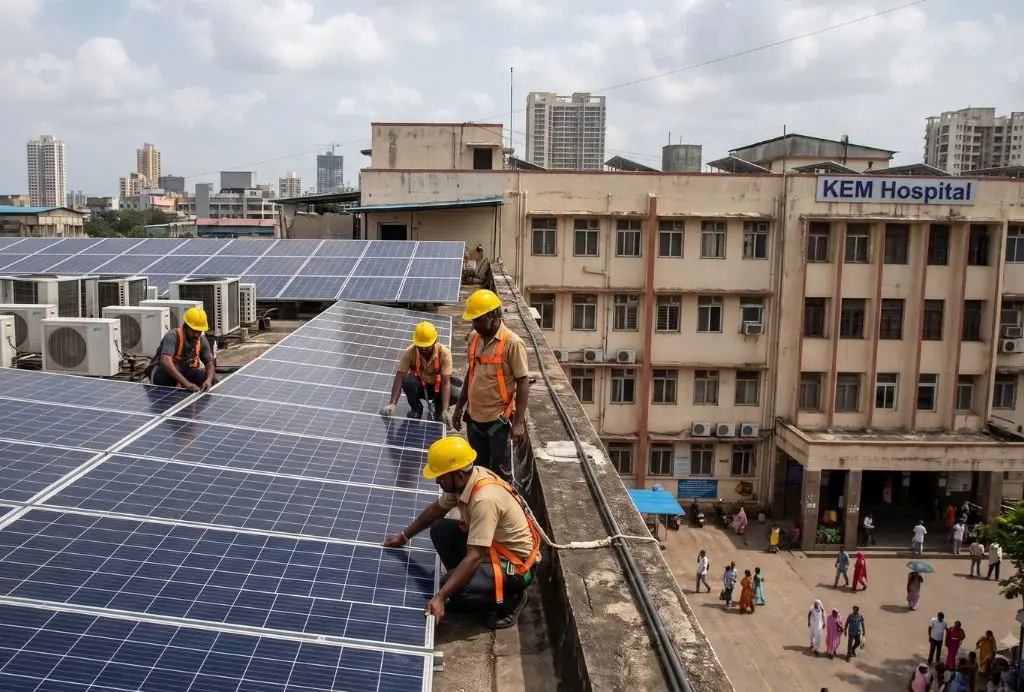

Solar for Offices and IT Parks in Chennai
An office uses most of its power between nine and six, the hours a rooftop array generates. Air conditioning alone accounts for about 55 percent of the electricity a commercial building uses, and it peaks in the hottest part of the afternoon.
Two things make an office different from a factory. First, the tariff depends on what the office does: an IT or ITES company pays the industrial rate in Tamil Nadu, while a bank, a consultancy or a corporate office pays the higher commercial rate. Second, many offices are tenants in a building or a tech park, which decides who can put solar on the roof at all.
Get an itemised proposalWhat decides the answer here
- IT and ITES offices pay the industrial tariff, HT I ₹7.50 or LT IIIB ₹8.25 a unit, under TNERC Tariff Order 6 of 2025. Ordinary offices, banks and business premises pay HT III ₹9.40 or LT V ₹10.45.
- Solar saves more per unit for a non-IT office, because each unit it replaces costs more.
- Weekends change the sizing. A five-day office exports its Saturday and Sunday generation at ₹3.37 a unit, so size to the weekday load, not the roof.
- A tenant can install solar if it holds its own TNPDCL connection and a lease over the roof area it uses.
- There is no capital subsidy for offices. Businesses get 40 percent accelerated depreciation and GST input credit instead.
Which tariff your office pays, and what solar saves
Tamil Nadu bills information technology services, as defined in the state ICT Policy 2008, on the industrial tariff. The definition covers software development, application testing, back-office and KPO work, contact centres and data centres. Every other office, private or government, along with banks and business premises, is on the commercial tariff.
The network charge is levied on every unit the plant generates. The ₹608 per kVA monthly demand charge on HT supply is set by your peak demand and usually does not fall with solar, so leave it out of the saving.
TNERC has no separate tariff for an IT park as a whole. A developer's common-area connection pays according to its own use, so check the category printed on the bill before any proposal assumes a rate.
What a 100 kW office plant earns
A 100 kW rooftop costs ₹41 to ₹47 lakh including GST in 2026, about ₹37.6 to ₹43.2 lakh before GST, which a GST-registered business claims back (see 100 kW solar plant cost). It generates about 1,60,000 units a year. A five-day office uses about 85 percent of that on site and exports the rest, mostly on weekends, at ₹3.37 a unit.
Worked on 1,36,000 units used on site at the net saving above, plus 24,000 exported units at ₹3.37 less the ₹1.04 network charge. A seven-day operation, such as a 24-hour contact centre or a data centre, uses more of its generation and pays back faster.
Tenants, tech parks and who can install
The rooftop solar regulations allow any consumer who owns the premises or holds them legally, including on rent or lease, to install a plant. In practice that means three situations.
You own the building
The simplest case. One connection, one plant, and if the campus has several blocks, a generation meter for each inverter set, added together for billing.
You are a tenant with your own TNPDCL connection
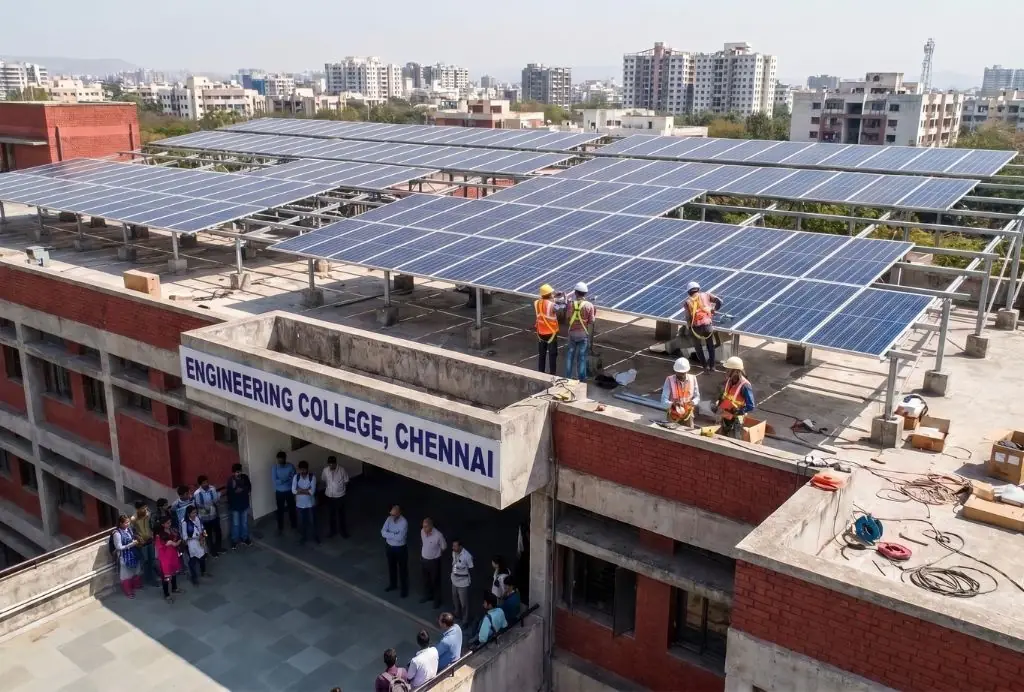
You can install on the roof area your lease gives you. Get the landlord's written consent and a lease clause covering the roof, the cable route to your meter and access for cleaning, before you sign a proposal.
The building has one connection and sub-meters tenants
Here the connection holder, usually the owner or park operator, is the only one who can install, and the HT agreement does not allow resale of power to tenants without TNPDCL's written sanction. Group net metering and virtual net metering, which would let one plant serve several connections, exist only as a 2024 draft in Tamil Nadu, for domestic and government consumers. Do not buy a proposal that depends on them.
Building code, approvals and the roof
- New large buildings must keep a solar zone. Under the Tamil Nadu Energy Conservation Building Code Rules 2022, commercial buildings of 2,000 sq m built-up area, 100 kW connected load or 120 kVA contract demand and above must reserve a shade-free renewable energy zone of at least a third of the roof, or the area needed to generate 1 percent of peak demand, whichever is less.
- Plants above 10 kW need Electrical Inspectorate approval, a two-stage online process of drawing approval and then a safety certificate.
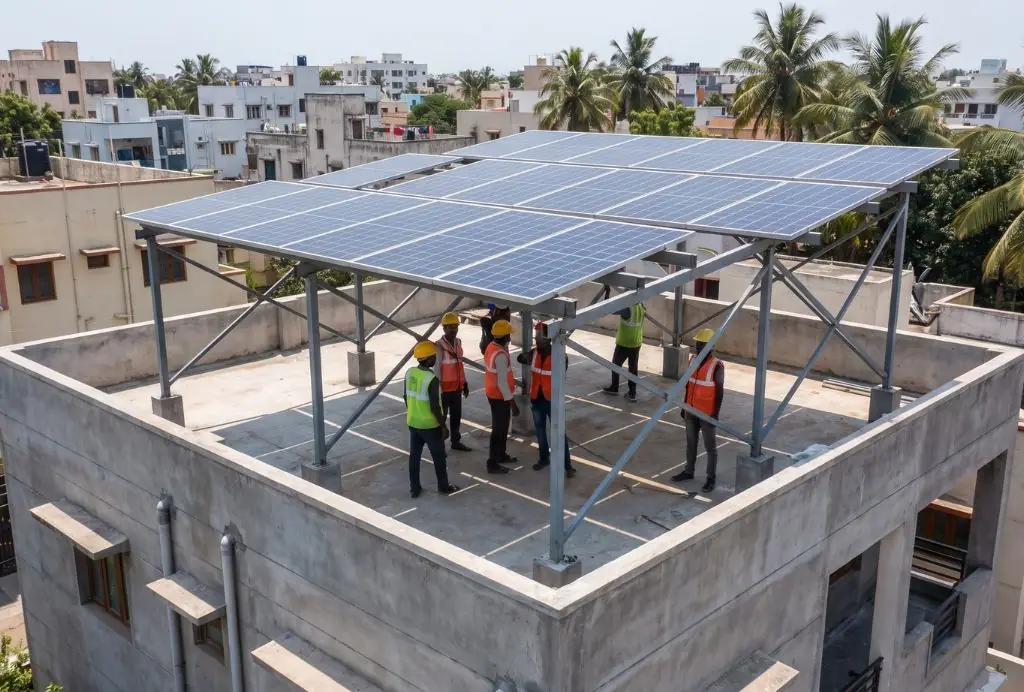
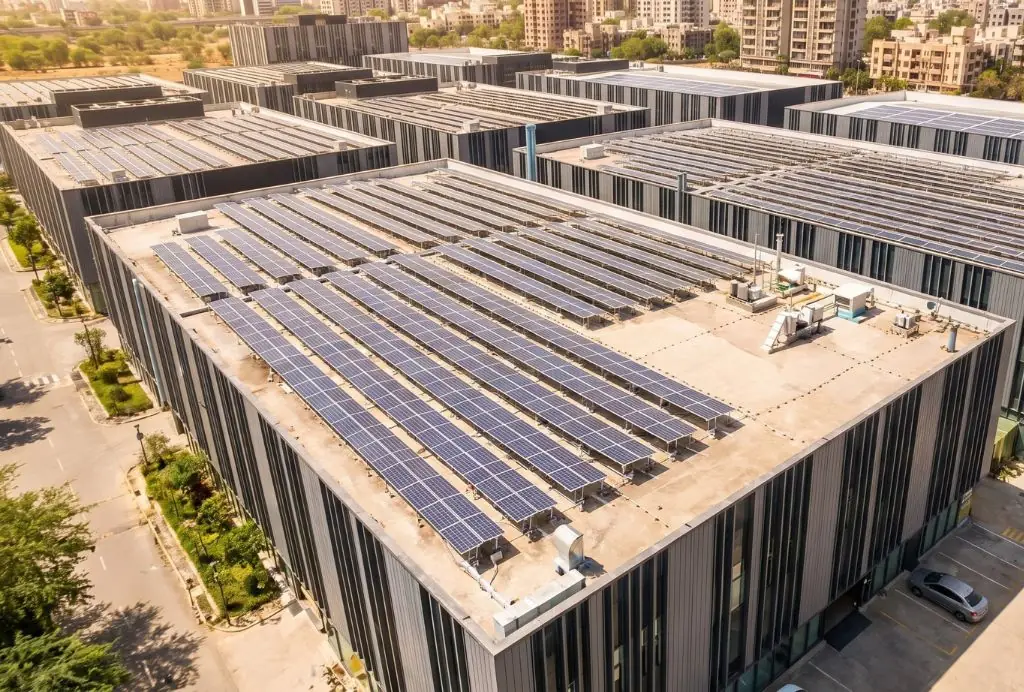
- Office roofs are crowded. Chillers, cooling towers, tanks, lift rooms and DG sets take space and cast shadows. An elevated structure over plant areas often recovers the roof.
- Capacity cannot exceed the sanctioned load, and capacity is capped at your sanctioned load.
The tax side
There is no capital subsidy for an office plant; PM Surya Ghar is residential only. A business claims accelerated depreciation at 40 percent a year instead, or 20 percent in year one if the plant runs for under 180 days that year. GST on a turnkey contract works out near 8.9 percent, creditable for a GST-registered business. If you would rather not own the plant, the OPEX model lets a developer sell you the power at a fixed rate.
Frequently asked questions
What electricity tariff do IT companies pay in Tamil Nadu?
IT and ITES services, as defined in the Tamil Nadu ICT Policy 2008, are billed on the industrial tariff: HT I at ₹7.50 a unit plus ₹608 per kVA demand charge, or LT IIIB at ₹8.25 a unit. Other offices pay the commercial tariff, HT III ₹9.40 or LT V ₹10.45.
Is rooftop solar worth it for an office in Chennai?
Usually yes. A commercial office on HT III saves about ₹11.9 lakh a year from a 100 kW plant, a simple payback of about 3.2 to 3.6 years. An IT office on the industrial tariff saves less per unit, about 4 to 4.6 years payback.
Can a tenant install solar on an office building?
Yes, if the tenant has its own TNPDCL service connection and legal possession of the roof area through its lease. Get the landlord's written consent and a lease clause covering the roof, cabling and access.
Can one solar plant supply all tenants of an IT park?
Not through net metering today. Group and virtual net metering exist only as a 2024 draft in Tamil Nadu, for domestic and government consumers, and the HT agreement bars resale to tenants without TNPDCL's written sanction.
Do new office buildings in Tamil Nadu need solar?
New commercial buildings of 2,000 sq m, 100 kW connected load or 120 kVA contract demand and above must reserve a shade-free renewable energy zone under the Tamil Nadu ECBC Rules 2022. The higher ECBC+ and SuperECBC tiers require installed generation.
How should an office size its solar plant?
To the weekday daytime load. A five-day office exports its weekend generation at ₹3.37 a unit, under half what it saves on a weekday, so a plant sized to the roof rather than the load earns less per rupee.
Send your bills and a roof photo
Twelve months of bills, the tariff category printed on them, your sanctioned load and a photograph of the roof are enough to size the plant and work out the payback.
If you are a tenant, send the roof clause of your lease too. For larger sites see commercial solar cost per kW; we work as a solar EPC company in Chennai across Chennai's office corridors.
Call +91 98841 07170Sources
TNERC, Suo-motu Tariff Order No. 6 of 2025, 30 June 2025: HT I, LT IIIB (including IT services as defined in the ICT Policy 2008), HT III and LT V tariffs; network charges
TNERC, Order No. 4 of 2026, 27 April 2026: ₹0.80 network charge for LT IIIB
Government of Tamil Nadu, ICT Policy 2018, section 5.3.3: power tariff for IT and ITES as notified by TNERC
TNERC, Grid Interactive Solar PV Energy Generating System Regulations 2021 (GISS-23-1, 7 October 2021), Regulations 4.7 and 5.3
TNERC, Tamil Nadu Electricity Distribution Code (consolidated to 31 March 2024), Form-8 HT agreement, clause 3 on resale of energy
TNERC draft GISS Regulations 2024 (June 2024), group and virtual net metering proposals; DT Next, 15 June 2024
Government of Tamil Nadu, Energy Conservation Building Code Rules 2022, section 7.2.8 and Tables 7-6, 7-7
Electrical Inspectorate, Government of Tamil Nadu: approval of solar PV plants above 10 kW
TERI, Existing Commercial Building Retrofit Guidelines, 2019: HVAC about 55 percent of commercial building electricity
Income-tax Rules 2026, Appendix I item 8(xiii); CBIC Notification No. 9/2025-Central Tax (Rate), S.No. 437